June 28, 2010

Football, Fracking, Folly: stupid things we keep doing.

Three stories in the overall category, "why do we do such stupid things?"

Football and Brain Injuries

The brain of the late Cincinnati receiver Chris Henry contained so many signs of chronic disease... that it shows a football player can sustain life-altering head trauma without ever being diagnosed with a concussion.

Dr. Bennet Omalu: "I'm not calling for the eradication of football; no, I'm asking for full disclosure to the players. Like the surgeon general considers smoking to be dangerous to your health, repeated impacts of the brain are dangerous to your health and will affect you later in life. Period. The players need to know this.

"I think it's an epidemic. It's beneath the radar. We simply didn't identify it [early and properly].

"The NFL wants us to believe that documented concussions are the issue. I've always believed that it's not about documented concussions. It's about repeated impacts to the head ... sub-concussions," Dr. Omalu said. "The issue is repeated impact, repeated blows to the head."
Encouraging children to play football is so reckless that it makes soccer and the World Cup seem rational.

What a fracking mess

Today's Vanity Fair presents an account of fracking operations in Damascus, PA and Dimock, PA in order to exploit the natural gas found in the Marcellus Shale. Both towns are in the Delaware River basin watershed.

The story tells about one family whose (post-fracking) well-water eroded their plates in the dishwasher, made their children dizzy after they took showers, and eventually could be set on fire as it came out of the faucet.

Folly: Losing Afghanistan

Today's Economist (reg. req'd) talks about our failure in Afganistan. Although we're ostensibly fighting the Taliban and al Queda, the corrupt Karzai government has announced plans to seek a diplomatic rapprochement with them. Karzai is also manuevering with Pakistan to cement his Pashtun tribe's power.

Even Henry Kissinger (the godfather of American Realpolitik) says that what we're doing and saying is a formula for failure. I'm all for killing bad guys over there, but I'm not convinced that we're not creating more bad guys than we're killing.

I really, really, really hate to quote John Kerry, but his rhetoric fits this situation perfectly. How do you ask somebody to be the last man to die for a mistake? How can we tell a grieving parent that the loss was justified, when the Afghan president and congress are both cutting deals with the purported enemy?
June 26, 2010

France's Jeannie Longo offers Lance some hope

From France, we have news that Jeannie Longo, 51-year old veteran cyclist, has won the national title in the individual time trial at the French national cycling championship.

From VeloNews:
Jeannie Longo won her 57th national title at the French national championships on Thursday, decisively winning the women’s time trial event for a third successive year.

The 51-year-old Longo covered the 24.7-km course in Chantonnay a full 1:19 faster than two-time national champion Edwige Pitel, 43. Former national road champion Christel Ferrier-Bruneau, 30, finished third at 1:45.

The win represents Longo’s 57th French national title since she won her first in 1979... Longo’s presence in the women’s cycling peloton, whose average age is usually half her own, has on occasion prompted the odd grumble. However the Frenchwoman known for her no-nonsense attitude has always defended her right to compete, no matter what her age.

That belief was vindicated Thursday, when, asked why her rivals could not match up, she suggested they “hadn’t done enough specific training. I’m sorry to say it, but they need to go back to the drawing board on a few things.”

“You can’t discount my 30 years of experience,” added Longo, who actually won her first national championship jersey 31 years ago.
I like the notion of the peleton grumbling at the lady's age.

As Americans, of course, we view all cycling events through the lens of: What does this mean for Lance? Perhaps this is the year for age and treachery triumphing over youth and skill.

Pictured Alberto Contador (current heir apparent) and Lance Armstrong (who was something, once); Contador wears the yellow jersey.
June 25, 2010

Gatorade, Exercise, and My Type 2 II Diabetes


I usually don't blog about personal events because (1) I lack any perspective on them, (2) nobody would find them that interesting, and (3) I don't have much of value to say. But I had an experience recently that I wanted to blog about, if only to have this post appear when somebody else googles "Type 2 Diabetes Gatorade exercise".


I am not a Doctor (IANAD), I am not a Lawyer (IANAL) and probably neither are you. You should see your doctor with your questions. This is just my anecdote. And you know what they say: the plural of anecdote is not information.

I'm a Type II diabetic and a Cyldesdale bicyclist. I've ridden several long, multi-day rides with my Type II diabetes, which is (mostly) in control. These long rides are 80 to 100 miles a day for up to four days, mostly TOSRV and DC-Pittsburgh.

In 2010 I was preparing for another long ride, and my prep rides were turning out to be mostly 20 miles long with the occasional 40-miler. That's not as long as they should be, but my time was tight. I was drinking water and eating power bars and packets of honey on the bike.

As the ride approached I started getting all my gear on the bike and started doing what I'd be doing on the ride, which included drinking Gatorade. In previous years I drank a 50% gatorade/water mix, but this year I started drinking more straight Gatorade. I don't know why.

A curious thing started happening to me when I rode. After an hour, maybe at 1h+15m, I'd feel a blood sugar crash - loss of energy, nervousness, feelings of impending collapse. I'd get off the bike, eat something and drink some Gatorade, and it would pass. I'd get back on the bike, ride for a half-hour, and then the same thing. For the rest of the ride it would be a thirty-minute ride with a twenty-minute break. I figured I wasn't being disciplined enough with my eating.

I went on the DC to Pittsburgh ride. We started in DC and after an hour I started to feel the crash coming on. I'd been focusing on hydrating (gatorade) the whole ride, but I drank some more Gatorade and pressed on. By 1+30 I was feeling terrible and abandoned the day's ride, because I was in a group and I didn't want to hold them up.

Each of the next few days, I'd ride for an hour and crash. Drink more Gatorade, get back on the bike, a half-hour then another crash. So I rode with the group for the first and last 90 minutes each day. It was not the ride I'd hoped to have, and although I really enjoyed the riding I got, I was disappointed to be a DNF and verklempt to think my long rides were over.

Back home I kept riding, and I noticed my daily mileages were slipping from 20 miles, to 15 miles, to 12 miles. Each ride I'd have an energy crash about an hour into it. Finally I tested my blood sugar during a ride and the numbers were very high, 255 mg/dl.

I had thought my problem was that my diabetes was interfering with the bike riding, but then the thought occurred: could it be something I was doing on the bike was interfering with my diabetes? Which led me to: Could it be drinking the Gatorade?

So I Googled "Is drinking Gatorade safe for diabetics" and found this opinion, which said No, it's not. There's a few other similar opinions on the web.

Gatorade and Exercise ~ Diabetic Poisoning For Me

Your mileage may vary, but I found that when I removed the Gatorade and replaced it with water the situation improved dramatically, to the point where I now think I was practically poisoning myself with the Gatorade.


Gatorade contains a lot of carbs, simple sugars, and electrolytes designed to get into your bloodstream quite rapidly. Apparently for me this really spiked my blood sugar which screwed up my energy levels. When I cut out the Gatorade I felt like my old self on the bike again.

To be clear: Gatorade is not poisonous, it's just really, really bad for me. I've read that's it's actually useful for Type 1 diabetes and for people with low blood sugar. The manufacturers aren't evil people.

To repeat, this is just my experience, you should talk with your doctor. Just providing food for thought.
June 23, 2010

The Pirate's Shining Moment of 2010

From the Post-Gazette's Dan Majors:

Pirates put pierogi back in the race

Andrew Kurtz, one of the men who perform as a racing pierogi during Pirates' home games, has been rehired by the team after management determined that "he should not have been fired" for posting a disparaging remark about the team on the Internet.

"The fact of the matter is that neither HR nor senior management were involved in the decision to fire the employee," Mr. Warecki said. "When they were made aware of the improper termination on Friday evening, they conducted an investigation into the firing. Upon learning the facts of the case and determining that he should not have been fired, [management] contacted the employee Saturday morning to offer him his job back, and he accepted." The bad publicity, Mr. Warecki said, did not factor into the decision.

"He was rehired on Saturday morning because it was the right thing to do," Mr. Warecki said. "That same decision would have been made of any employee who was let go in this manner, whether it was reported in the media or not."

They can say the publicity didn't matter.
They can say they'd skipped a step on the HR checklist.
They can say whatever they need to say, now.

They manned up and did the right thing. Bravo.


-

2politicalJunkies: Primo Post

My compliments to 2PoliticalJunkies and their wonderful post Who Knew?. This is a candidate for Blog Post of The Year.
June 22, 2010

Historian Rebuilds First Bicycle; Original Inventor Killed by Ÿagoff Pintek

From Metro.com.uk comes news that Chinese historian Xu Quan Long has found ancient plans of the first bicycle and has rebuilt a working model.

Previously, the earliest known example of a bicycle was the wooden 'velocipede' invented by German engineer Baron Karl von Drais in 1817. It wasn't until the development of metal-framed 'boneshakers' in France in the 1860s that bicycling began to achieve popularity.

Xu Quan Long said he stumbled across the drawings while studying the works of legendary ancient Chinese inventor Lǔ Bān (魯班), who was born more than 2,500 years ago. He then recreated the original design using materials available at that time.


Xu Quan Long said that Lǔ Bān's notes regarding the bicycle were unfinished. Other documents writted by Lǔ Bān's students in the same year suggest that he was actually killed while riding his bicycle. Lǔ Bān was struck from behind by a horse-drawn carriage driven by a "blue eyed devil" named Ÿagoff K. Pintek, who later wrote in his own journal that he (Pintek) had just invented a game called "bump the biker".

Even 2500 years ago, Ÿagoff K. Pintek's actions were so egregious that his name became a byword for boorish behavior. According to Wikipedia, as his infamy spread the Chinese were unable to pronounce his unusual first name and they settled on Jagoff. Chinese literature from that time is replete with comments like, "don't be a such a Jagoff, one Pintek is too many". Graffiti found at the site of the terra cotta warriors in Shaanxi Province has been translated as saying, "your ancestors are Jagoffs". His legacy is memorialized in modern times by the use of his name as a pejorative reference.

Jagoff Pintek's direct descendent, Mike Pintek, is a disk jockey and talk-radio personality who was recently noted in Pittsburgh for expressing his own desires to bump and/or frighten bicyclists. Although (Mike) Pintek later acknowledged that "mistakes were made", he has not apologized, retracted, or corrected his outrageous comments.

An apology sounds like this: I said insert actual comment here. I shouldn't have. I was wrong. I am sorry. I apologize. I will not do it again.

An apology does not sound like this: Did I say things that weren't smart? Sure. Did some people take offense? Yes. But what I meant to say was insert something completely different here.

He's making the old Ÿagoff proud.
June 20, 2010

KDKA's Mike Pintek is a Dangerous Idiot

Truly an excellent post by Illyrias titled, Do Bicyclists Deserve to Be Attacked?.
Illyrias refers to several reports of local violence against people on bikes, and then quotes local radio voice Mike Pintek whose was interviewing Bill Nesper of the League of American Bicyclists:
Mike Pintek said: "There are some bicyclists who are just these arrogant little dorks that think that they can do anything they want because they're on a bicycle and we're being green and environmentally friendly."
A Pittsburgh Blog that's new to me and quite excellent is Lolly's Reimagine an Urban Paradise. In Dearest Station Manager: Fire Mike Pintek, Lolly relays this about Mike Pintek:
He further went on to state that cyclists “are arrogant dorks” that are “lucky to be alive” and that he has the desire to “bump them” with his vehicle.

I cannot believe that KDKA would allow a man to advocate violence against cyclists. “Bumping” a cyclist would certainly result in severe physical harm and would likely cause broken bones and possibly death.


KDKA's Mike Pintek: Wait, There's More!

In another post, Mike Pintek Should Lose His Drivers License and His Job, she provides this transcript of Pintek's bike foolishness:
I’ve gotta tell you they’ve been times when I’ve come around a curve on a country road and you’ve got three of em abreast in MY lane and they’re just lucky they’re alive. Because, am I WRONG?

There are some bicyclists who are just these arrogant little dorks that think they can do anything they want because they’re on a bicycle and ‘we’re being green and environmentally friendly”…

I have been thoroughly tempted — I haven’t done it cuz I’m not going to do it — I’m not that kind of person… but I have been so tempted to just bump em.

I have been so tempted to pull up behind them when they’re doing this — you know spread out across the road — put my car in neutral, jam the accelorator down, race the engine, and scare the living crap out of them.

They’ve got to stop being so arrogant about what they’re doing. They’ve got to obey the rules. they have to do the right thing or else they’re going to get killed.

 So, first things first: I hope you'll send an email to KDKA program director Marshall Adams, madams@kdka.com, who is Mike Pintek's boss and responsible for what Mike Pintek says on the station's behalf (over the public's airwaves). Tell Mr. Adams what you think of Mike Pintek promoting violence against bikes.


The report is that Mike Pintek will address these bicycle issues on his Monday show, 12noon to 3pm Local, on KDKA radio.

This presents me with a pragmatic dilemma. I understand that Mike Pintek is an entertainer, a panderer to our darker tendencies, a pot-stirrer whose value-add for his employers is that he says things outrageous enough to keep the audience enduring the advertisements that are the basis of his paycheck.

My dilemma is that I don't want to be Pintek's chump, proving his effectiveness. I don't want to tune in and listen, because that meets the needs of Pintek and his advertisers. I don't want to reward the dangerous, idiotic behavior.

I called Marshall Adams, Mike Pintek's boss. He wouldn't disavow or disapprove Pintek's comments. His only refrain, repeated a few times, was a suggestion that I call into the show and participate in the discussion. They're shills and provocateurs. I can't feed the trolls.

In the end, I've decided that all I can do is to do my part to see that when somebody types "Mike Pintek", or "Mike Pintek KDKA" into Google, they see my comments. I believe in free speech. I just can't tolerate a paid entertainer and scoundrel (and that's what he is) advocating violence by people in cars against bicyclists. I've also got reservations about post-peak hacks who make their living fomenting controversy without contributing solutions or having skin in the game.


It's interesting (if somewhat sad) to look through Mike Pintek's website, which has a picture of him with Shimon Peres back in the glory days. I guess he looked young compared to Shimon Peres, fifteen years ago. It reminds me of this song:

June 19, 2010

The Truthful Pierogi and "Not About This Year"

Ah, the Pirates. For quite a while recently, they've been on the verge of pulling off one of the greatest public relations dodges in Pittsburgh sports history. Since 2009 they've gotten Pirates fans to repeat their koolaid: The difference now is they’re building for the future.

It's not about this year, it's about three years from now. What a great shovelful of nonsense. I want to be able to say, "Yes, I suck at my job. Yes, I'm the worst in the industry. No, it's not about this year - it's about my 2013 results. You wait and see". This is a better con job than the PAT bus authority blaming their fiscal problems on the bus drivers.

The "it's not about this year" meme, which is kind of funny in a business where they keep so many statistics on annual performance (first place, the World Series, personnel contracts, etc) was becoming widely accepted, it was often repeated, and it was on the verge of becoming an Accepted Truth.

"It's not about this year!" Don't you think that BP wishes that they'd said that to Congress? "Mr. Senator, we're not in this for the short haul; we're in this for the five-year plan. That's why we're not rushing into action, and we're not giving you any indication that we're accountable for this year's results."

Unfortunately the Pirates have snatched defeat from the jaws of victory and offended the web 2.0 community. People may not care themselves about Blogging, Tweeting, and Texting, but they really do defend the notion that people should be permitted to do it. Fundamental American concept, and all that.

The Pirates have terminated an occasional employee who worked as an unknown, masked distraction from their actual performance.

Andrew Kurtz, 24 years old, of New Brighton, gets inside the costume of an overstuffed Pierogi for the staged "pierogi races" held at the new stadium the taxpayers bought to keep a world-class team in Pittsburgh. Mr. Kurtz is paid $25 for each of the occasional home games he works at, usually four per month, and is paid $50 for appearing at local publicity events. He's a runner who managed to find some small cash pursuing his hobby.

Mr. Kurtz had the unfortunate impulse to make a FaceBook post about Pirates team president Frank Coonelly's stealth decision to extend the contracts of GM Neal Huntington and manager John Russell. Mr. Coonelly did not see fit to announce the extension initially, presumably because it's in the future and after all, we're not about this year. (Coonelly's dissembling has been called LiarGate by Bob Smizik.)

Mr. Kurtz's Facebook entry read:
"Coonelly extended the contracts of Russell and Huntington through the 2011 season. That means a 19-straight losing streak. Way to go Pirates."
Four hours later he was fired.

The Pirates have unwittingly unleashed the Streisand Effect upon themselves, in which an unwise decision to try to control unwelcome web 2.0 content results in the unwelcome info getting more attention than it ever would have if they'd just left it alone. (Previously mentioned here.) Would any of us have heard of Mr. Kurtz or his Facebook page if the Pirates hadn't been silly enough to fire him?

Out of the mouth of a pierogi, we get the truth: The Emperor has no clothes. The Pirates can't control the ballgame, so they're trying to control the truth about the management team.

Even a pierogi from New Brighton (NTTAWWT) can see the corruption in that.

Mr. Kurtz's mother, who probably does not have a blog or a facebook, called a strike a strike:
"My son always was a big Pirates fan... He took pride in being a pierogi runner. Since when, in this country, are you not allowed to state an opinion? Well, here is my opinion: The Pirates came through again and let go one of their biggest fans and dedicated workers."
June 18, 2010

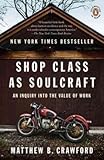
Finished, Shop Class as Soulcraft

Finished reading Shop Class as Soulcraft: An Inquiry into the Value of Work, by Matthew B. Crawford. Crawford is a Ph.D. (political philosophy) who left academia to make his living as a motorcycle mechanic. This book is an expansion of an essay originally published in the journal The New Atlantis, and the essay is a fine introduction to Crawford's thoughts.


Crawford talks about the psychic appeal of manual labor, and points out that it is in dealing with the physical world that we interact with reality, and that those who do manual labor usually have to improvise based on the situation at hand - a decision-making process that improves with experience, requires thoughtfulness, and presents an objective measure of success - things often lacking in contemporary work.


He talks about the crafts and the teaching of a craft to young people, providing an arena for failure, learning, and the development of pragmatism. He talks about the degradation of blue-collar work, then of the degradation of white-collar work, and explains that by removing judgement and discretion from the worker (wearing any color collar), Corporations are moving the thinking part of the job into the corporate process, and dumbing down, demeaning, and removing opportunities for excellence and mastery from the employee's realm. The book is a cultural rebuke to the field of knowledge management. Crawford suggests that the blue-collar, hands-on jobs considered "low" by today's culture may actually provide for more intellectual work that office jobs do.

Crawford encourages young people to go to college for an education, and to learn a craft for a livelihood. He points out that plumbers, electricians, and mechanics haven't faced outsourcing and overseas competition because the physical nature of their work and the fact that the worker must adapt to the specific situation at hand makes these fields incompatible with "knowledge management" and "process improvement" - he makes the point that when you want a deck on your house, you hire a local, not somebody in China.

He recognizes the complexity of modern life and sets a simple virtuous standard for interacting with the modern world - he calls for achieving "a mastery over your own stuff", being able to fix and maintain your own property and devices.


In my own experience, I take a small pleasure in repairing flat tires on my bicycle and then patching and re-using the tubes, not because it saves a bit of money and reduces waste, but because it permits me to interact with the thing-in-itself, it lets me work on my own "stuff", and it is clearly done either well or poorly.

I really enjoyed the way Crawford describes the increasingly lost concept of the journeyman, and teases out the tension between judgment and decision making on one hand and on slavish attention to rules and procedures on the other hand. He points out that although Rules may permit untrained inexperienced people to handle basic-to-normal situations, Judgment will develop journeymen who can adapt and resolve difficult-to-complex situations. This was a particularly pleasing part of the book, because the spectrum between judgment and rules is of great interest to me (I fall with Crawford in favor of Judgement).

Philosophically, he suggests a chosen life focused on the physical rather than the virtual or administrative, a work focused on livelihood rather than self-esteem, the development of judgement rather than rule-following, and a participation in the local rather than the global economy.

I found the book very similar to Robert Pirsig's Zen and the Art of Motorcycle Maintenance: An Inquiry into Values, but curiously the somewhat negative NYTimes book review specifically says that this is not Pirsig Part Two. Having read the book, I disagree with the NYTimes reviewer; I did not find that the book has "a chip on its shoulder", but rather found that it suggested an alternative approach to the admin 2.0 workplace, in a manner that continued Pirsig's line of thought.

This was an excellent book and I recommend it.
June 17, 2010

So, You Should Make Less, They Say

I'm seeing an anti-salary bias among people who should know better.
       PAT bus finances screwed up? Bad, overpaid bus drivers.
       School district facing a pinch? Bad, overpaid teachers.
       Lose 9, 12 games in a row? Bad, overpaid players oops

At one time it was just Jack Kelly, but now it's spreading. I'm reading a lot of comments like this: Somebody with a GED makes more than me, and I have a master's degree? That is just wrong.

Taking up the last, first: if you spent $120K on a BS/BA and can only find a job that pays $25K, or you only choose to take a job that pays $25K, or you can only get a job that pays $25K - you really didn't make a wise decision, did you? So stop telling people about it.

Does the economy owe you a certain income because you have a degree? That's a spirit of entitlement that seems directly opposed to the fiscal austerity these skinflint pity-me-MFA's seem to espouse when it comes to others.

Let's apply the Categorical Imperative. Would it be all right if everybody pursued the "I deserve xyz income level because I spent four six years in college" benefit? Do we owe our veterans who spend four six years in Afghanistan and Iraq a certain income? If we don't justify it for four years in Iraq, it's certainly not justified by four years at Podunk State.

Economic Schadenfreude

To revert to the first (and larger) issue: the desire to see other people make less is nothing but than the internalization of the Corporate desire to keep salaries low. Capital learned a lesson when they started paying Labor for their time: when you pay people more, at a certain point they'll find an equilibrium at which they're willing to curtail their efforts because they've earned enough. To prevent this employee empowerment, and to ensure a steady supply of dependent laborers, Capital will always seek to suppress wages.

I understand why Capital (and later, the Corporation) seeks to suppress wages; it's in their rational self-interest. What I don't understand is the desire among Citizens to see other people make less.

The middle class has seen an unprecedented reduction of their buying power since the 70's; that's (part of) why two parents now work to procure the livelihood that one parent used to generate. Largely because of the loss of manufacturing, the erosion of union power, and the WalMarting of America, real incomes have been continually reduced. There's a word for it: Deflation, which can lead to Depression, which can lead to Collapse.

Some segments of the labor force have managed to hold onto good salaries and good working conditions. Generally, they're established, unionized, blue collar, and they're often public employees. They "elite manqué" who've invested in certain success only to see their dreams dashed by the Corporate abandonment of the old Social Contract are presented with a discontinuity: that bus driver is making more than me, and I've got a Master's Degree. Something must have gone wrong here. Can't be me. Must be them!

Cognitive Dissonance is a funny thing. (It's a great blog, too.) When presented with the evidence, nobody races to say "gee, maybe I didn't make a smart decision when I spent $75K pursuing an advanced degree in Aramaic n'at"; instead, people race to find fault with those who are succeeding. "Gee, those rat bastard bus drivers, they have a union, they've banded together and they're screwing the whole city! And last year, one of them was rude to my cousin Effie's classmate's Aunt!"

And yet, these people consider themselves educated.

As our society becomes more complex and increasingly interdependent, there really aren't too many "unimportant" jobs.
       The plumber who keeps the sewage out of my bathtub? Priceless.
       The tech who fixes the MRI that scans the shadow in my chest? Priceless.
       The clerk who handles my direct deposit? Priceless.
       A bus driver who fights Pittsburgh traffic and deals with The Public? Priceless.
       The teacher who educates my children? Priceless.

I want more people to make more money, not less. It's okay if they make more than I do. What would happen if they made more, if they all made more? They'd have more to spend. They'd buy more. They'd be less stressed. They'd go fishing more often. They'd make economic decisions beyond survival. They'd have better lives. The stress and pressure would shift to the employers and management. That's all good.

Where would the more come from? It is a zero-sum world; it's all, who eats whose lunch? Let's shift the wealth from the Corporations, who would be considering pathological if they were really people, to Labor.

Less you think I'm naive or too theoretical, let me acknowledge that all power bases result in some abuse. Should all PAT driver overtime go to the most senior drivers, and then should it count in the retirement calculation? No. Should teachers have no accountability for the performance of their students? No. How did these abuses happen?


Who set up these situations? The "managers" who bargained with the union, who said "I need this from you, I'll give you this in return". And now that everybody isn't getting the same amount of ice cream, some people want to renounce the deal. Who picked the people who bargained? You did, Mr. Voter. Quick question: who was the last person that you elected as Mayor of Pittsburgh? Yeah, I thought so.

It's not the teachers, bus drivers, or the ballplayers. It's the school board, the Port Authority CEO, and the Management. (edit)

If working people get mad at each other and bicker and snipe at those who make more, we're dividing ourselves, focusing on the wrong definitions, and advancing the Corporate agenda.

We need a greater common denominator, not a lowest common denominator.

(And - I'm sorry about this - but you're no John Galt, either.)
June 16, 2010

One of these things is not like the others

One of these things is different from the rest:
It's great that politicians are getting positive feedback and press opportunities for improving bicycling in Pittsburgh. It's terrible that the area still equates killing a cyclist with killing a deer.

June 15, 2010

Worst Case Scenario: Imagining a Spill at Somerset Wind Farm

I have a friend named Bob W. and he is the most well-balanced person I have known. Whenever change or uncertainty are afoot, he'd ask people, "What's the worst thing that could happen? What would that look like?" Then he'd suggest ways to handle the worst-case scenario, and generally people had a better handle on things after they talked with Bob.

Which makes me wonder. Suppose for a moment we weren't fracking Marcellus Shale, and we weren't drilling for oil 5000 feet underwater. Suppose we were doing something other than drilling. What would be different?

Suppose we had windfarms instead of oil wells and fracking operations. But let's not rush into it; let's consider the downside. What's the worst that could happen, as Bob would ask, if we used windfarms instead of drilling for oil? What would that look like?

The worst that could happen, I suggest, is that the wind farm could have an unprecedented spill.

What would the Post Gazette look like the morning after the worst-case scenario came to pass, and we had a "spill event" at the Somerset Wind Farm?


Hat Tip: here, here, and here.
June 14, 2010

Gallons, Quarts, Pints, Cups: Measuring Up

There are concepts that I get, and then there are things I don't get. Some of my cognitive deficiencies are improvable, some have available workarounds, but there are some concepts I just don't process well. If I were a computer, we'd speculate that my Operating System had a few bits corrupted during installation. (insert BSoD joke here)

Something I've never been able to deal with normally is gallons, quarts, pints, and cups. I can deal with volume in the metric system effectively, and I can handle multivariable calculus, but somewhere between cups and quarts I become a blank-faced idiot.

My wife might ask me to go to the store and buy a quart of milk, which is a reasonable request but one which evokes in me a dread usually reserved for shopping for feminine products. I usually revert to asking "that's the tall thin one, not the tall thick one, right?". When you add the complexity of whole, 2%, 1%, skim -- I'm not up to it. It's not me at my most impressive.


Today the intertubes delivered this infographic by Emma Christensen of The Kitchn (via Lifehacker) which hopes to convey the relationship between these archaic units.

It would be a public service and a great kindness if stores would display this graphic wherever milk and paint are sold.

The store that did so would have my loyalty forever.

Or, maybe there's an App for that?
June 12, 2010

Weekdays Southside Trail Closure

Temporary Trail Closure to begin June 21st on South Side Trail

PITTSBURGH, Pa. (June 11, 2010) A temporary Trail closure will soon begin
along a portion of the Three Rivers Heritage Trail as part of the Pennsylvania
American Water's Becks Run Pumping Station Replacement Project. The Trail
closure will be in place starting June 21, 2010 through early spring 2011. The
1.5-mile portion of the Trail being affected runs roughly from Water Street at
the Steelers practice facility to the dead end of the Trail adjacent to the
Glenwood Bridge. Signs will soon alert Trail users to the closure and note that
the Trail will be open and usable every weekend during the project from Friday
at 4:30 through Sunday evenings.

Thomas Baxter, Director, of Friends of the Riverfront stated, "It's unfortunate
to close the Trail for several months during the week, but we are pleased that
Pennsylvania American Water will open it on the weekends and restore the Trail
completely. Both the City of Pittsburgh and Urban Redevelopment Authority agreed
to a quick schedule of nine months, largely during the winter, and repeatedly
stressed that this project has to be done and is imperative for our region's
safe drinking water. I'm happy that they understand the need to complete this
project quickly before the last section of the Great Allegheny Passage is open.
Once that happens, another closure will be almost impossible."

Pennsylvania American Water will be making upgrades to its intake structure
located along the trail on the Monongahela River. These upgrades will
necessitate the use of the trail by construction vehicles and create a
potentially unsafe situation for trail users during project work hours.

"We understand that closing several miles of the Three Rivers Heritage Trail
will cause some inconvenience, but we have worked closely with all the partners,
including the City of Pittsburgh, Urban Redevelopment Authority and Friends of
the Riverfront, to ensure the safety of trail users and the timely completion of
the project," said Pennsylvania American Water External Affairs Manger Gary
Lobaugh.

Additional details on the project in relation are available on the Trail Status Page at
here.

June 11, 2010

Oops! Fiddling with Flip Flops, Kills Cyclist

In today's Post Gazette:
Driver was untangling flip-flops when he killed cyclist
Friday, June 11, 2010
By Jim McKinnon, Pittsburgh Post-Gazette

A teen driver was distracted when his flip-flops got tangled with his truck's pedals, causing him to strike and kill a bicyclist last month in Indiana Township, Allegheny County homicide investigators said today.

No charges have been filed against the 17-year-old boy who had been driving the pickup truck. The District Attorney's office will review the investigative reports to determine whether charges should be filed.

Deputy District Attorney Chris Conners said this morning the matter is under review.

Donald Parker, 52, of Hampton, died May 27 after his bicycle was struck from behind by the boy's pickup truck as the two traveled up a steep grade on Harts Run Road near Dorseyville Road.

The boy told police he had been on his way to school at Fox Chapel Area High School when his flip-flops got tangled in the floor pedals.

The driver, while the truck still was moving, reached down to untangle his feet when the vehicle struck Mr. Parker, who had been riding near the berm ahead of the truck.

"The flip-flops caused a momentary distraction that took [the driver] to the berm, and he struck the bicyclist," said county police Lt. William Palmer.

The boy's name has not been released.
Why is it a tolerable (even permissable) error to kill a cyclist in Pennsylvania? Why is killing a legally operating cyclist (with a wife and kids) treated the same as killing a deer?
Question: In Pennsylvania, what's the difference between
               killing a deer and killing a bicyclist?
Answer:People feel sorry for the poor deer.

Does vehicular manslaughter mean anything in Pennsylvania? Why do we keep secret the identity of people who kill bicyclists, but we release the names of the dead victim?

How did we end the pattern of deaths caused by drunk driving? Punishment and publicity. How can we get the equivalent of MADD? Can we call it PAKC, People Against Killing Cyclists? Please contribute your suggestion for catchy alliterative names in the comments.
June 10, 2010

Degree Density : Pittsburgh Shows Well

From Extraordinary Observations, (via BoingBoing): a graphic of the number of people with college degrees (bachelor or higher) per square mile.


  • My three favorite other cities are SFO, NYC, and BOS, and there they are at the top of the list.
  • Yes, I see where Cleveland is.
  • No, they didn't spell Baltimore correctly.
  • No, they don't have more people with graduate degrees in those cities because they hire more cab drivers.
June 09, 2010

Labor Strikes in Foshan, China and Chennai, India

Remarkable news in the NYT (via Nullspace): Power Grows for Striking Chinese:
Honda Motors said Tuesday that workers at a parts plant had walked off the job just days after the company settled a separate strike by agreeing to substantial pay raises for 1,900 workers at its transmission factory.

The new walkout, at an exhaust-system factory in the city of Foshan, will force Honda to halt work Wednesday at one of its four auto assembly plants in China, the company said.

The assembly plants had just reopened after closing for almost two weeks because of the earlier strike at the transmission factory, which is also in Foshan.


And in Bloomberg/Business Week we see, "Honda Plants in China to Stay Shut Tomorrow as Strikes Spread":
The car-assembly plants in Guangzhou, Guangdong province will be closed for a second day after employees at a parts supplier stopped work demanding higher pay, said a Honda spokeswoman. Another supplier in Guangdong halted production today because of a strike, said Gao Xia, a Honda spokeswoman in Beijing.
While the Chinese Communists (and remember, that is who's in charge) will not permit any challenge to their own authority, it's nice to see that they're willing to permit labor strikes which challenge companies from outside the Great Firewall.

In the Wall Street Journal we read that Hyundai Motor Co's factory in Chennai, in the southern Indian state of Tamil Nadu, agreed to consider reinstating 35 of the 67 employees it fired last December in order to settle a strike that closed the factory for three days.

Also in Chennai, employees at Nokia's plant are striking after the company suspended an employee for refusing to work a different shift on short notice. After he was suspended, more workers joined to protest against the suspension and they were also suspended, he told the newspaper. The union claimed that about 2,000 staff were on strike, and production of nearly 100,000 mobile handsets was disrupted following the strike

What is going on here?
What is going on there, that isn't happening here?

A strike is terrible - it can take a family a long time to recoup wages lost during a strike - and so it's hard to see reports of any strike and say, "that's a good thing". But the strike, although terrible, gives the workers an essential tool and permits them to say "we will shut down rather than accept this". I would sooner live and work in a place where workers can strike rather than a place where workers cannot strike.

This is good news - not in a schadenfreude sort of way - but good news in the sense that these people are standing up for themselves and demanding a fair wage and good conditions.

It's good news that they're organizing to the degree that they can force the Capital and Capital's Managers to pay attention to them, and it's good news that they're willing to take risks and bear costs to stand in solidarity. There are things, apparently, that Chinese and Indian factory workers will object to.

This is good news because organized labor and the right to strike are fundamental to the establishment and success of a middle class, and because organized labor in China and India will improve the lot of billions of people. Labor strikes, the capability of withholding your labor, are a fundamental human right.

This is also good news because the "China Price", long the bane of US manufacturing, may begin to reflect more realistic costs. The American worker is the most productive in the world, and I believe we can compete with anybody given a fair market. This may move us closer to that.

We've lost the notion of the labor strike in America. We lost it in 1981, we lost it as Capital moved manufacturing jobs overseas, and we lost it when we deluded ourselves into thinking strikes were something we'd moved beyond. The middle class and the American dream suffer from the loss of the labor strike. Maybe it's time for the pendulum to swing back.

When was the last major American strike that closed a major factory? Capital doesn't have any problem closing a factory when it's beneficial to them. (We note that National Nurses United has scheduled a one-day strike on Thursday June 10 in Minnesota.)

Is it possible that Communist China and India can be doing better on labor/human rights than America?

(hat tip: Nullspace.)
June 07, 2010

Pity the Poor HomeOwners,
Blessed be the Renters

In today's Wall Street Journal Richard Florida suggests Homeownership Is Overrated. Dr. Florida's Psalms would probably include, 'Blessed be the Renters, for they shall be unfettered, flexible, and free to seize new opportunities in the face of economic change'.

It's a theme he's worked before, repackaged into this year's book - because when you sell memes, the long term market is in repackaged updates and niche versions.

Florida is a champion of the creative class and professes that cities which attract the creative class and positions them in close proximity often requiring vertical development (ie, tall buildings) will enjoy the benefits of the 2.0 Economy, whereas cities that eschew the creative class - by being intolerant, parochial, widespread, and having a lot of people who own homes rather than rent - will suffer the wrath of the 2.0 Economy.

Perhaps the most unsettling (to me, anyway) of Florida's assertions is that homeownership is an artifact of the post World War II economy, and that today's bright people are avoiding homeownership - and selling their homes, at times, to dupes who don't quite get it yet.


Florida suggests that the residential real estate markets in legacy, non-2.0 cities were Ponzi schemes in which subsequent buyers fueled the profits of earlier buyers - and he believes that the pyramid has started to collapse in an upheaval he calls The Great Reset.


When the economy in a city goes sour - when Hometown Inc shuts down, or when the digital capital clicks elsewhere - people who own homes are stuck with them; they have reduced mobility, and in a 2.0 world mobility and agility may be key. In such a world, Florida suggests that homeownership is a liability. Furthermore, government policies that encourage homeownership may result in unintended outcomes, calcifying the economy to the point of lost competitiveness vis-a-vis the Third World.

Florida suggests that in the last two economic downturns, metro areas with higher homeownership rates have suffered from higher unemployment rates. His researchers have found that homeownership is a more significant predictor of higher unemployment than other more readily accepted parameters.

It's not just Richard Florida. Paul Krugman has similar thoughts. Clive Crook also makes a similar argument. So does Roger Lowenstein.

A Slate article about broadly accepted concepts that may be fallacies lists this one: Homeownership is better for us.
The assumption that owning beats renting has been the basis for American social policy since at least the New Deal, when Congress first insured and subsidized mortgages through the Federal Housing Administration and Fannie Mae. Over time, the long-standing tax deductibility of interests evolved into a specific mortgage-interest deduction. It's a natural assumption that owners have more of a stake in their communities. But even if that's true, why should it outweigh the obvious disadvantages of homeownership? As many more people have discovered lately, it means taking on enormous financial risk. It encourages community involvement at the expense of labor-market mobility. It encourages longer commutes. And at least one study says it makes you fat and unhappy.
Florida isn't an absolutist; homeownership isn't always bad, but it should be reduced to provide a more efficient workforce. Owning a home, he suggests, would be acceptable for people with stable jobs, high incomes, low risk, and capable of making long-term decisions.

I remember reading a science fiction book about a future dystopian society. In the beginning the narrator refers to a minor character who keeps to herself in her apartment, smells funny, and seems suspicious of others - and the narrator discerns from her yellow-stained fingers that the old lady is one of the few remaining addicts. That exposition set the stage for a future society in which today's social artifacts are considered anachronistic and their original context is lost. How would a future society regard the last furtive smokers? What will they think of the last Nascar fan? What would a future archeologist make of a Roethlisberger jersey?

Which makes me wonder, how will future society regard the last Homeowners if Richard Florida's thesis is borne out over time?

Future themes of class distinction will feature character types such Seizers and
HomeOwners. The Seizers will flit from job to job, enduring unemployment
until the next gig arrives, updating their skills to meet the current corporate vogue, and moving from city to city as the job market demands. In doing so they will disturb families, children, relationships; they will avoid church, community and committments that may ensnare them to the flypaper; they will be perfect for the needs of Corporations, nimble hungry mobile economic units (or desperate transient
near-homeless temps, depending on whether you're one of them or if you're
hiring them).

Among the older people there will be a few furtive HomeOwners, captives of their
households, tied down to their locale, networked into the community, not too
eager to move to the next town for the next job. They're probably raising children in families. They'd seeking a level of wages that is perhaps inefficient for the Corporations. They'd be likely to join unions to improve their lot.

These marginalized HomeOwners will also be the people that coach Little League soccer, join the neighborhood association, pay attention to the Water Authority, and - in general - constitute the civic community. You'll see them at school, in church, and at the hardware store. The HomeOwners will probably try to explain to the Seizers that at one time, homeownership was the American dream; they'll explain that they're not really interested in changing cities every ten years.

The rootless wizards of the new economy 2.1 will probably view them with pity. These misguided legacy wretches must not have seen the powerpoint.

I sure hope Richard Florida is wrong, because his future marginalized HomeOwners seem a lot like me and a lot like Pittsburgh.

June 06, 2010

(Solar) Weather Delays: A Curious Juxtaposition

I had two headlines in my inbox that suggest a curious juxtaposition.

First was a story about Boeing ATC being awarded a major research & development support contract worth up to $1.7 billion for the Next-Generation Air Transportation System. They're going to shift from air traffic control to air traffic management.

A large portion of this effort is moving from a ground-based system to a space-based system, moving facilities from the (existing) ground grid to satellites, and moving decision making from the (existing) command-and-control structure to a systemic, profitability-sensitive collaborative model.

Which is good news for primary beneficiaries Boeing, Lockheed Martin, Airbus and Cessna, and secondary beneficiaries Adacel, Ensco, Embry-Riddle Aeronautical University, Harris, Honeywell, Jeppesen, Jerry Thompson & Associates, Mosaic ATM, Spectrum Software Technology, Tetra Tech ATM, and the Washington Consulting Group. The entire military-industrial complex is eating at this trough.

Second is a story from NASA about expected increases in solar activity over the next decade, which have the ability to compromise GPS, satellites, space-based systems, and datalink communications.

The new National Space Weather Program notes how "people of the 21st-century rely on high-tech systems for the basics of daily life. Smart power grids, GPS navigation, air travel, financial services and emergency radio communications can all be knocked out by intense solar activity. A century-class solar storm, the Academy warned, could cause twenty times more economic damage than Hurricane Katrina."

I'm just wondering: are they reading each other's press releases?

June 05, 2010

Lists and Unlists


Interesting new Burgh blog: http://theunlisteds.blogspot.com/ which seems to be a response to http://infinonymous.blogspot.com

Full Flights and High Fares

Grownups Need Helmets, Too
June 04, 2010

DC to Pittsburgh Bike Trip

Trip report online of DC to Pittsburgh Bike trip.

June 02, 2010

Clarifying Some Terms


Matt Bors
June 01, 2010

DC - Pittsburgh Bike Trip: Distance and Elevation Chart

Compiled from a few reliable sources, here's a table of distances (in miles) and elevation (in feet above Mean Sea Level) riding from Washington, DC to Cumberland, MD via the C&O Canal, then continuing from Cumberland MD to Pittsburgh, PA via the Great Allegheny Passage.


   Miles  elev 'MSL
Georgetown  0  72
Great Falls  14  140
White's Ferry  35  213
Point of Rocks  48  233
Brunswick  55  246
Harper's Ferry  59  299
Shepherdstown  73  322
Wiliamsport  99  380
Hancock  124  446
Little Orleans  141  502
PawPaw  151  492
OldTown  161  568
Cumberland  184  610
Frostburg  200  1801
Meyersdale  216  2416
Garrett  221  1916
Rockwood  228  1801
Confluence  246  1340
Ohiopyle  258  1230
Connellsville  272  856
Perryopolis  287  797
Smithton  292  771
West Newton  298  761
Buena Vista  305  787
Boston  312  745
McKeesport  316  750
Point State Park 334  720


Which produces an elevation profile that looks something like this:

The elevation profile isn't perfectly accurate (it relies on a approximation of an altimeter) but it serves to give an idea of the relative slope, eastbound versus westbound, at the Eastern Continental Divide.

This is a chart that can easily mislead; the horizontal scale is 350 miles, while the vertical scale is 1/2 of a mile.