
In Wisconsin a General Strike has been called for by two labor organizations, the South Central Federation of Labor and the Industrial Workers of the World (IWW, or Wobblies).

From SCFL.org:
The South Central Federation of Labor is an umbrella organization for 97 labor unions representing 45,000 workers in Dane, Dodge, Sauk, Columbia, Jefferson and Iowa counties in the state of Wisconsin.
Just as workers join together to form unions because there is strength in numbers and collective action, unions join together in Central Labor Councils, like SCFL, for the same reasons. There are 600 Central Labor Councils throughout the United States. In essence, the purpose of any Central Labor Council is solidarity between unions in a given geographic area.
Just as workers join together to form unions because there is strength in numbers and collective action, unions join together in Central Labor Councils, like SCFL, for the same reasons. There are 600 Central Labor Councils throughout the United States. In essence, the purpose of any Central Labor Council is solidarity between unions in a given geographic area.
From Business Insider:
The South Central Federation of Labor, an umbrella organization representing more than 45,000 workers in Wisconsin, voted last night to endorse a Wisconsin general strike if the state legislature passes Gov. Scott Walker's budget, the Wisconsin State Journal reports.From Labor Union Report, a story about the IWW:
Delegates of the 97-union federation voted unanimously in favor of the strike, and called for the group to start educating members on the "organization and function of a Wisconsin general strike."
... the [Industrial Workers of the World] Wobblies have been around since 1905 and, although the IWW has declined significantly since its 100,000-member peak in 1923, it has been getting some recent notice trying to unionize Starbucks and Jimmie John’s.The Wobblies are an interesting group with their own vernacular (see, for instance, Jerusalem Slim). Locally, they go back to the 1909 McKees Rocks strike. (In fact, this 1909 Pittsburgh newspaper clipping describes the plant owner in terms that could be used for today's Governor Walker.) From Wikipedia:
The IWW has historically supported the concept of the general strike — all workers uniting to shut down commerce. In 1919, the IWW and other Leftists were successful in a general strike in Seattle. Since then, while there have been industry-wide strikes in the U.S., there have not been general strikes in the United States.
[Wisconsin Governor] Walker still won’t budge from his position. It will take something bigger from the unions and the working-class as a whole: a general strike, which will show Walker that millions are willing to fight his agenda.
The IWW was founded in Chicago in 1905 at a convention of socialists, anarchists, and radical trade unionists from all over the United States who disagreed with the policies of the American Federation of Labor (AFL).
In particular, the IWW was organized because of the belief that the AFL was structured by narrow craft principles which divided groups of workers, while the Wobblies believed that all workers should organize as a class.
The IWW motto was "an injury to one is an injury to all", which broadened the 19th century Knights of Labor's creed, "an injury to one is the concern of all." When founded, IWW was the only American union (besides the Knights of Labor) to welcome all workers including women, immigrants, and African Americans into the same organization.
The IWW has produced a Wisconsin general strike pamphlet and these posters:
 |  |  |
This might become more interesting.


 , by Matthew B. Crawford. Crawford is a Ph.D. (political philosophy) who left academia to make his living as a motorcycle mechanic. This book is an expansion of an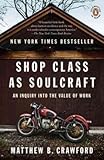
 He talks about the crafts and the teaching of a craft to young people, providing an arena for failure, learning, and the development of pragmatism. He talks about the degradation of blue-collar work, then of the degradation of white-collar work, and explains that by removing judgement and discretion from the worker (wearing
  Crawford encourages young people to go to college for an education, and to learn a craft for a livelihood. He points out that plumbers, electricians, and mechanics haven't faced outsourcing and overseas competition because the physical nature of their work and the fact that the worker must adapt to the specific situation at hand makes these fields incompatible with "knowledge management" and "process improvement" - he makes the point that when you want a deck on your house, you hire a local, not somebody in China.
 In my own experience, I take a small pleasure in repairing flat tires on my bicycle and then patching and re-using the tubes, not because it saves a bit of money and reduces waste, but because it permits me to interact with the
  , but curiously the somewhat negative
 Posts
Posts

