I enjoyed the comic on the blog, which deals with the topic of Creation vs. Exploitation, and the role of the Artist and the Craftsman.

Today I feel like I'm Jerry Lewis in a small way, which is to say I am a Petit Genius in France.
According to Google Chrome, the blog post reads like this:
It's classic. A computer scientist, a cook, a tailor, a carpenter or any talented person wants to put his talent to good use. He wants to profit more than just a pay check in exchange for his time. So he goes into business!This is what the web was made for. Five geeks in France, referring to an American blog in their conversation. Tres Magnifique !
Suddenly, all of the creativity that made this person an artist is now going into operations details: staff management, cash flow management, growth management, sales development, advertising and marketing, etc.
The creator becomes an exploiter. Or operator. Whatever. The important thing is that his work will be less and less creative.
Mechanics and The Garage
One of my former bosses once told me "If you love to work as a mechanic and want to continue to love it, do not run a garage". It applies to all professions and to all people who earn their living with their talent.
The only exception are the real people-skills businessmen. They can sell jet-skis or mattresses, it's still sales and business development. These people, their talent is to get talented people together, to "place the pieces" as they say!
Creativity and exploitation as the devil and holy water
The creation process is chaotic, it is anything but organized and structured. We do not force creativity, it must be cultivated. It is often more creative to be on vacation than in the office. I often joke that I'm going to brainstorm during a bike ride. It is during these moments that I'm most creative, not sitting at the desk between two phones. The exploitation process is linear, organized, structured, right, square. You're unable to exploit while mountain biking. Exploitation is the opposite of creativity.
Creativity is my capacity and my fault. My talent is applied science, not the basic sciences or administration. What I do best is to find solutions to real problems, to sell practical solutions. I do not revolutionize the theory of relativity or become the CEO of Google. Instead, I will take a fax and radio and make a radiofax simply because someone has expressed a need.
Creativity is an essential qualification for starting a business from scratch, but it becomes a handicap when the business becomes operational. One, that's not what makes us tick as an individual and two, we tend to improvise. The focus is no longer on the talent in which one excels; it is now in all the distractions around you. In the long term, it is ideal for disaster. An artist who wants to play the manager is going to eat Kraft Dinner for a very long time.
So what? The designer is left with two choices. First, remove the emotional creative people as soon as it becomes exploitation. Second, surround himself with managers who will operate and leave him free in creation.
In short, this aspect of entrepreneurship is misjudged, probably due to an excess of idealism. What designer does not want to change the world? In reality, it's more complicated! We should let another control the production. Fortunately, solutions exist, and the designer-entrepreneur will find it. If it were easy, what would be the fun of going into business?


 , by Matthew B. Crawford. Crawford is a Ph.D. (political philosophy) who left academia to make his living as a motorcycle mechanic. This book is an expansion of an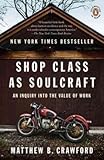
 He talks about the crafts and the teaching of a craft to young people, providing an arena for failure, learning, and the development of pragmatism. He talks about the degradation of blue-collar work, then of the degradation of white-collar work, and explains that by removing judgement and discretion from the worker (wearing
  Crawford encourages young people to go to college for an education, and to learn a craft for a livelihood. He points out that plumbers, electricians, and mechanics haven't faced outsourcing and overseas competition because the physical nature of their work and the fact that the worker must adapt to the specific situation at hand makes these fields incompatible with "knowledge management" and "process improvement" - he makes the point that when you want a deck on your house, you hire a local, not somebody in China.
 In my own experience, I take a small pleasure in repairing flat tires on my bicycle and then patching and re-using the tubes, not because it saves a bit of money and reduces waste, but because it permits me to interact with the
  , but curiously the somewhat negative
  , by Patricia Pitcher. (Link leads to PDF).
 Posts
Posts

