Tag Cloud      TLA      About
Saturday, July 31, 2010

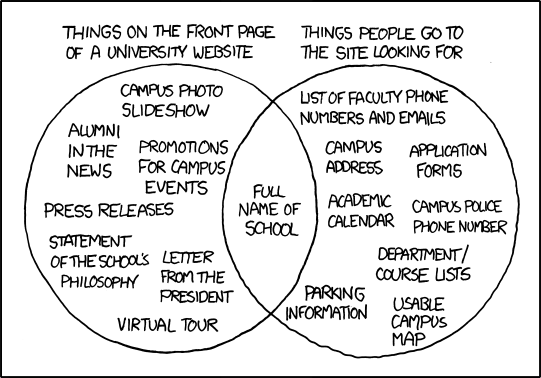
Home Page Venn Diagram

Websites, Venn Diagrams, I just had to:

Wednesday, July 28, 2010

Selling Parking Garages in Pittsburgh : Me, Too!

One of Pittsburgh's current imbroglios is the impending sale or long-term lease of Pittsburgh's parking garages. Luke'n'at wants to lease the garages to corporations who will run them as long-term moneymakers in return for a short-term cash payment to the city. This would alleviate some of the political pressure on Pittsburgh politicians, but probably not significantly address the underlying financial issues.


Let's think this through with our "look back™" glasses. The original idea behind garages was to have parking so people could easily do business. The original idea behind meters was to keep a churning supply of short-term parking available for people using local businesses, rather than letting employees and neighbors block the prime spots. Cities once operated garages and parking meters as a public good. Are you old enough to remember that?

The garages and meters have become an industry in their own right, and the original concept is lost. Now the garages and meters exist to take a certain amount of money out of the population for the city's budget, and that money turns parking into a power center with its own priorities, profits, bureaucracy, jobs, and followers. When Luke'n'at sells the garages, the city budget gets a one-time windfall and a long-term income stream, and the taxpayers pay a lot more money over time. People pay more money, government takes in more money- how is that not a tax increase?

And, of course, a corporation gets to be the middleman, diddling the public and taking their share of every dollar. The politicians will get to blame the corporations and save face. The great perversion is that parking (which was once a public good marshalled for local economic benefits) will become overpriced, which will cause unintended consequences that are exactly the opposite of the original intent. All those pennies come from somewhere.

I have a garage, and I've got a near-term cash-flow that's constraining my style a bit. I'm thinking of selling or leasing my garage. I mean, if all those smart people in the city think it's a good financial move, why shouldn't I get in on it?


There's going to be a few problems in the transition. I'm going to have to get all my stuff out of the garage. I'm going to have to implement some sort of Smart-Parking-App on my iPad to track my leasing payments and all that money that'll be rolling in. This would be a great time for somebody from CMU to develop a personal EasyPass reader, so that the sub-contractor could easily charge cars as they come and go. I'll need to it be compatible with Windows 98, please. Just saying.

There's probably an opportunity for extra value-added (and I'm always looking for value-added). It's possible that I could provide upscale coffee beverages for parking clients, let them use my WiFi, sell them maps of the color belts, things like that. I could probably write off my snow blower as an expense.

It's a silly example, but not without intent. If it doesn't make sense, if it's not pragmatic for you to lease out your garage, how does it make sense for the city to lease out it's garages? Where does the supposed new money come from?

The cost will be born by the public, and the pain will be felt by the communities and small business. The only money that will move in this transaction is from the developers and wannabees to the politicians. Which brings us full circle to Luke'n'at.
Tuesday, July 27, 2010

Geek Merit Badges

A recent comment by Nullspace has led me down the rabbit hole again, to emerge only after seeing unexpected things and with a portion of my life irretrievably spent. Nullspace wrapped up his eloquent essay Passing Parking Pontifications by saying "I'll award anybody who's read this whole post a merit badge".

This got me to thinking: What kinds of merit badges would you invent for blogs? The mother of merit badges, of course, is Scouting. Among the existing and legitimate merit badges that might apply to this blog, I found these two, for computers and bicycling.


But wait there's more! The New York Times suggests a merit badge for providing your family with home tech support. Are you keeping your Mom's wifi network running? Kind of locked into it, whether you want to or not? This badge is for you.


The website Nerd Merit Badges offers several merit badges for your purchase, including this merit badge for achieving "Zero Email Bounce", which is the condition of keeping an empty inbox. I strive for ZEB, but my progress to date has left me convinced that it's a journey (ZEB-vana?) rather than a realistic goal.


Nerd Merit Badges also offers a merit badge for "full stack web developers". A full stack web developer is defined by Randy Schmidt as someone that does design, markup, styling, behavior, and programming.


Science Scouts offers a lengthy list of geek merit badges (digital only, but isn't that what we're all about?) for downloading. My favorite right off the bat is the "interdisciplinary merit badge", AKA the "Somewhat confused as to what scientific field I actually belong to" badge. I like to think of it as a Venn Diagram Merit Badge.

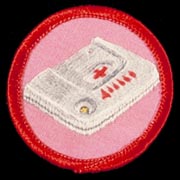
Lest we seem a misogynist, let me point out that artist Mary Yeager has produced series of female-oriented merit badges, including badges for various rites of passage for women. The badge to the right celebrates "at-home pregnancy test". It's a pretty thorough list of merit badges.


Final question: what would a Burgh merit badge be? What would you do to earn it?
Friday, July 23, 2010

King of the Mountain, Individual Time Trial and the Tour de Montour

We've discussed the polka-dotted KOM (King of the Mountain) jersey in this space recently - the KOM is the best mountain climber in the Tour de France, currently Anthony Charteau of team BBox Bouygues Telecom.

We've also discussed the Yellow Jersey (the maillot jaune) which is reserved for the race winner. Currently the yellow jersey is worn by Alberto Contador of the Astana team.

The final winner of the Tour de France will be determined by an Individual Time Trial (ITT). Whereas most Tour stages are contested by teams, with various roles and strategies within the teams, the Individual Time Trial is just the bicyclist against the clock - no drafting, no helping, just the individual and the unforgiving distance. The ITT is almost always held on a flat course, and so there are two types of specialists in the peleton - there are climbers and there are ITT specialists, and usually they are two distinct groups.

It is rare unheard of to mix the ITT with a climbing event.

On September 25, here in Pittsburgh, there will be a mountain individual time trial, combining both worlds. The 2010 Tour the Montour includes a new King of the Mountain event.

Those competing in the Tour the Montour KOM event will be timed individually up a 7/10ths of a mile long hill (Hassam Rd - closed to traffic, not part of the trail). At an average of an 8% grade, the man and woman with the fastest times will truly be the "King" and "Queen" of the Mountain and will receive a special bicycling jersey for their effort.

Here's a link to the registration form.
Thursday, July 22, 2010

Polka Dot Jersey: King of the Mountains (KOM)

Monday, July 19, 2010

ChainGate, Tour de France, and Web 2.0

In today's Tour de France, Stage 15, the two leading contenders - Andy Schleck in the yellow jersey, and Alberto Contador who was thirty seconds behind him - were climbing the final hill of the day. The hill was "hors categorie" (without category, or more appropriately beyond categorization).

The moment came for the competitors to accelerate. Andy Schleck shifted into a higher gear and pushed the pedals hard, resulting in his chain coming off the gears. Schleck came to a stop, wrestled with the chain, and got back in the race - but he lost 39 seconds to Contador, and at the end of the stage he was 8 seconds behind instead of 31 seconds ahead.

Contador made enough time out of Schleck's mechanical misfortune to move from second place into first place, and to wear the yellow jersey at the end of the day. There was some jeering from the crowd when he appeared on the podium to put on the maillot jeaune, accusing him with poor sportsmanship in capitalizing on Schleck's mechanical.

In some other Tours, the two main rivals have treated each other with great courtesy. Famously, Lance Armstrong waited for Jan Ullrich in 2001 when he had a problem, and in 2003 Jan Ullrich returned the favor and waited for Lance Armstrong when he went down.

In this year's tour, Cancellara neutralized Stage 2 after a large accident delayed half the peloton. Significantly, when Contador was delayed in Stage 3, Andy Schleck did not wait for Contador.

Personally, I get Contador's decision to ride. Two other contenders, Sanchez and Menchov, were with them and continued to press on, and he couldn't take the risk of giving them time. What intrigues me is the way the dilemma played out in Web 2.0.

The Twitterverse was alive with comments about #chaingate. Riders from today's tour were contributing to the discussion. The pithiest tweet came from Gerard Vroomen, co-founder of the Cervelo TestTeam, who first posted : Contador just gained a great chance to win, but he lost the chance to win greatly. Poetry in less than 140 characters.

Later, after reflection, Vroomen updated: Alberto has a tiny point: Schleck didn't wait for him after the cobblestone crash so complaints about fair play ring hollow.

So these teams and athletes, whose payroll is driven by their representation of their corporate sponsors, are moving into Web2.0 to advance their cause. Before the end of the night, Alberto Contador has made this movie and posted it on YouTube:


This is professionally done, and very well done. What impresses me is the media effort that allows them to script, film, produce, sub-title and distribute an earnest bit of spin in less than eight hours after a potential negative public relations event. Very Web 2.0.
Sunday, July 18, 2010

Montour Trail Oasis: Enlow Station

Saturday I got to enjoy a bicycle ride with my daughter, and so I got to see something I've wanted to check out: the Enlow Station on the Montour Trail.


To get there, we took the newly-renumbered I376, Exit 56 (McClaren Road), drove away from the airport for about two miles and parked by the softball field.

We made a left turn onto the trail, which is a pretty optimal route for a young rider - there's a great illuminated tunnel on the trail, and the trail is quite flat. We rode east (getting off the bikes to cross two intersections) until it was time to turn around.

When we came back to the car we stopped at the Enlow Station, which is not quite a restored train station as much as an ice cream parlor fashioned out of a service station. Cold drinks, soft serve ice cream, hot dogs: all the needs of a recovering bicyclist.

There's not a lot of places along the Montour Trail to get a cold drink, let alone an excellent ice cream cone (I think of Farmhouse Coffee and the adjacent gyro shop as another oasis) and so I hope people will support the Enlow Station. Open seven days a week in the summer, 11am to 9pm.
Wednesday, July 14, 2010

Ohio River Trail: Coraopolis - Monaca - Beaver - Midland Bike Trail

But wait: there's more (good news about trails)!

The Ohio River Trail Council is working on a proposal to build a trail from Coraopolis, PA (north end of the Montour Trail) to Beaver, PA, and then to Midland PA on the Ohio/Pennsylvania border, where it ends close to the Columbiana, Ohio trail.


It's a very detailed proposal and the website includes some remarkably thorough documents identifying the history of the proposed route and all the municipalities and connections affected by the Ohio River Trail proposal. Also, there's a pretty informative Wikipedia page.

If When this is accomplished, you'd be able to ride from Midland to Washington DC on uninterrupted trails. Not everybody will do that, of course; it's enough that there will be a safe trail ride from Pittsburgh to Beaver, or from Monaca to Midland. You could certainly see people riding up from Pittsburgh, spending the night in a bed-and-breakfast, eating dinner at a restaurant, and riding back the next day.

(Midland, of course, is just a hop-skip-and-jump from the World's Largest Teapot. Talk about destination tourism!)

On the east side, this Ohio River Trail will connect to the Montour Trail, the Great Allegheny Passage, Cumberland MD and Washington DC. On the west side, the Ohio River Trail will be close to the East Liverpool-Cleveland trail they're building in Ohio, which connects to published trans-America routes. You couldn't build a new highway that would have a similar economic benefit.

The Ohio River Trail connects Beaver County to the existing trail system for Pittsburgh and DC, and will provide a future connection between the Cleveland trail system and Pittsburgh-DC. Who benefits? The benefits will accrue to the towns the trail passes through.

I believe that at the bottom line, in a zero-sum economy, these connected bike trails will do more for the economies of the towns they pass through than casinos will do for the places they're located. There's clean, green, fairly upscale money being generated in towns such as Frostburg, Meyersdale, Rockwood, Confluence, Connellsville, and West Newton. They've had their trails for a few years and are seeing real economic benefits from it. Towns like Coraopolis, Aliquippa, Monaca, Beaver and Midland will enjoy similar growth.
Tuesday, July 13, 2010

Great News for Pittsburgh Bike Trails

The last week has brought remarkably good news for Pittsburgh bike trails.

Two New Trail Bridges at Duquesne and Whitaker

By John Schmitz in the Post-Gazette on July 8th: County bridges all gaps but one in Pittsburgh-to-D.C. trail. Two new bike bridges have been placed across railroad tracks in Whitaker and Duquesne, PA.

The 170-foot bridge near Whitaker, which will have a 350-foot access ramp, will cross the tracks between Kennywood Park and the Rankin Bridge. The 137-foot bridge near Duquesne will have two 350-foot access ramps. The total cost of the bridge project is $3.5 million.

This will permit completion of the trail from the current terminus on Grant Street in Duguesne, beyond Kennywood, and connecting to the Waterfront Trail (which in turn leads to Sandcastle).

All that will remain incomplete on the Great Allegheny Passage after that is a one-mile stretch through Sandcastle Waterpark. Negotiations with the park owners have not produced an agreement that will allow the trail to go through.

"There's no solution just yet," Allegheny County spokesman Kevin Evanto said. "We're kind of at the same place we were a couple months ago."


Agreement Reached on Sandcastle Bike Trail

First seen at Pgh is a City, the Post Gazette's John Schmitz writes on July 13th:
Allegheny County and Sandcastle Waterpark are expected to announce an agreement within days that will allow completion of the last missing piece of a biking and hiking trail linking Pittsburgh and Washington, D.C.

"I really expect we'll have a formal announcement in the next couple days," said James Judy, vice president of operations for Palace Entertainment, owner of the park.

"I believe that is probably going to be the case," agreed county spokesman Kevin Evanto.


The combination of the two bridges and the Sandcastle agreement means that riding from downtown Pittsburgh to the main trail in Duquesne will no longer be a questionable, frightening act of courage along Route 837. It's going to be a ride you can take your children on and not be concerned about getting them killed. This is huge.

Amtrak Bike Service, Pittsburgh to DC, June '11

Posted in a message in the GAP Yahoo Group was an email message from Linda McKenna Boxx, President of the Allegheny Trail Alliance:
Yesterday at a meeting in Harrisburg, Amtrak officials announced that they would begin offering roll-on/roll-off bicycle service on the Capitol Limited by the end of June 2011!

This means that cyclists boarding at Pittsburgh, Connellsville, Cumberland, Harpers Ferry, Martinsburg, Rockville, or Washington, DC will be able to roll their bikes onto the train (reservations will be required; spaces will be limited at first), put them in a rack, and get off at any of these stops. Amtrak will be retrofitting several cars and needs to work out operational issues before the service can begin.

This is great news for all the towns along the Great Allegheny Passage and the C&O Canal towpath. This will add a great convenience and extra excitement to tourists who want to bike our great trail system.


This Amtrak announcement solves the logistical problem of making the round-trip without riding 700 miles; how do you get you, your bike, and your gear home after the bike ride? Now, if you're in Pittsburgh you can take the train to DC, disembark with your bike and start riding on the trail. Or, ride the trail from Pittsburgh to DC (my preferred direction), stay in the hostel and get on the next train to Pittsburgh.

My compliments to all involved.
Monday, July 12, 2010

The Limits of Software and the Advanced Automation System (AAS)

Finished reading "The Limits of Software: People, Projects, and Perspectives", by Robert Britcher. This was really an interesting book from a geek perspective and will probably end up as my second favorite book about software projects, along with Frederick Brooks' The Mythical Man-Month.

It was recommended in Don Brown's excellent blog Get The Flick, in separate posts here, here, here, here, and here.

The author describes major programming efforts he was involved in at IBM, starting with the Cold War's SAGE command-and-control system and the Apollo space program, moving into aviation with the 9020 Host and later the ARTS tracking system, and ending with the ill-fated Advanced Automation System (AAS), which was supposed to overhaul the national air traffic control system and ended up being both (1) the most expensive software project ever undertaken and (2) a debacle that all participants agreed to walk away from. One participant said, "It {AAS} may have been the greatest failure in the history of organized work."

Let me quote a brief description of the AAS snafu from the book:
One engineer I know described the AAS this way. You’re living in a modest house and you see the refrgerator going. The ice sometimes melts, and the door isn’t flush, and the repairman comes out, it seems, once a month. And now you notice it’s bulky and doesn’t save energy, and you’ve seen the new ones at Sears. So it’s time.

The first thing you do is look into some land a couple of states over and think about a new house. Then you get I.M. Pei and some of the other great architects and hold a design run-off. This takes awhile, so you have to put up with the fridge, which is now making a buzzing noise that keeps you awake at night. You look at several plans and even build a prototype or two.

Time goes on and you finally choose a design. There is a big bash before building starts. Then you build. And build. The celebrating continues; each brick thrills. Then you change your mind. You really wanted a Japanese house with redwood floors and a formal garden. So you start to re-engineer what you have. Move a few bricks and some sod. Finally, you have something that looks pretty good.

Then, one night, you go to bed and notice the buzzing in the refrigerator is gone. Something’s wrong. The silence keeps you awake. You’ve spent too much money! You don’t really want to move! And now you find out the kids don’t like the new house. In fact, your daughter says “I hate it”. So you cut your losses. Fifteen years and few billion dollars later, the old refridgerator is still running. Somehow.
I was predisposed to like this book for a few reasons: I think we fail to appreciate that there's very little new under the sun (VLNUS) and we fail to recognize that great strides were made in both programming and the art of software projects in the 1950's and 1960's. It didn't start with Bill Gates, Steve Jobs, or Tim Berners-Lee; they were late to the scene, and they stood on the shoulders of giants.

In The Limits of Software, the author tells the story of the early integrated systems of computers. Where Brooks wrote about the technical aspects of managing software projects, Britcher writes more about the artistic and cultural aspects, and the nature of programming itself (for instance: it's not a science). He says the secret to managing software projects is to "Superimpose onto the business of symbol writing the management practices of classic production, but allow for the eccentricities of the symbol writers." There are volumes of wisdom in that sentence that probably apply beyond the realm of software projects.

Britcher returns again and again to the importance of thorough and disciplined testing, and bemoans the absence of testing in modern software due to the eagerness to ship the product and the lack of familiarity with rigorous processes. He says he can easily tell which projects will definitely succeed and which will fail; projects that spend 60% of their budget on testing will succeed.

The technical approach used in the Advanced Automation System played a large part in its demise. The emphasis on programming in Ada seems indefensible in retrospect, but at the time it had all the buzz as the next great language and Ada eventually found a place in many critical DOD systems. Unfortunately, the AAS was an early adopter (if not the first adopter) of Ada, and the project bore an expensive learning curve.

Poorly defined requirements, scope creep, and the lack of a testing regime stacked the deck against AAS. The final fatal flaw was the immense funding stream in the hands of outsourced contractors who were paid for their time and not for results. The Beltway Bandits are willing to gorge at the trough even in a doomed project; the money is too good to interrupt the dance. The government contracts from AAS moved from away from IBM and into LORAL, which was then purchased by Lockheed Martin.

The features and business described in the Advanced Automation System did not die. The display work morphed into Sector Suites and Lockheed-Martin's DSR (Display System Replacement) program in the Enroute world, and into Raytheon's STARS program in the Terminal world. The drive for a "paperless" system (no printers) became Mitre's URET. IBM's 9020/Host automation replacement effort was reborn as Lockheed-Martin's ERAM, which may still not be immune to the issues that affected AAS.

Finally, the book seems to present an informed prelude to the impending multi-billion-dollar investment in the NextGen system, and so I hope the future architects take the time to study Britcher's book.

I think this would be an interesting read for those interested in software development, large-scale project management, or aviation automation.
Sunday, July 11, 2010

Cycling's Other Shoe About to Drop

The news in cycling isn't from VeloNews or CyclingNews as much as from the Wall Street Journal: U.S. Casts Wider Net in Probe of Cycling. (email reg. req'd). It's an interesting read. Key hook:
The U.S. criminal investigation, which is being led by the Food and Drug Administration, isn't aimed at prosecuting rank-and-file riders who used performance-enhancing drugs during their careers, according to people familiar with the investigation. Rather, it is designed to potentially bring charges against any team leaders and team directors who may have facilitated or encouraged doping by their riders.

FDA special agent Jeff Novitzky, the lead investigator, didn't return calls seeking comment.
Who is Jeff Novitzky, you ask? Jeff Novitzky is an agent for the Food and Drug Administration. Before April 2008 he was a special agent for the Internal Revenue Service who investigated the use of steroids in professional sports for over five years. His investigations have concerned Marion Jones, Barry Bonds, Bay Area Laboratory Co-operative (BALCO) and Kirk Radomski.

Assisting Novitzky is assistant U.S. Attorney Doug Miller, who works in the Major Frauds Section of the federal prosecutor's office in Los Angeles. Miller also had a role in the BALCO investigation.

The lead investigator is an IRS agent seconded to the FDA, and his lieutenant is a federal prosecutor. That's serious. That might lead to an endgame similar to Al Capone being sent to prison on tax evasion charges. Interesting questions include:
  • Did teams pay for doping programs with slushfunds that illegally avoided federal taxes?
  • Did the US Postal Team misuse federal funds?
In the end, perhaps the development of the Tour de France's visibility in the United States will result in its undoing.
Saturday, July 10, 2010

2010 Tour de Donut, Utah


I am not a person who visualizes himself ever riding a stage of the Tour de France, not even on one of the tour groups that rides along the route. But this week I learned of a Tour event that seems to be designed for me.

From FatCyclist.com comes news of the Utah Tour de Donut next week on July 17.

The Tour de Donut is a race that makes three loops around a seven mile course. Riders compete based on total time. But here's the trick: before each circuit, riders can eat as many donuts as they'd like. There's a bonus: for each donut consumed, three minutes is taken off the rider's total time.


As you can imagine, all the competitive nuances that apply to the Tour De France translate into the Tour de Donut. The preferred technique is to double-up on donuts, earning a six-minute bonus in the same amount of time. Junior riders known as domestiques can be tasked with ferrying donuts to more elite riders.


The gentlemen shown on the right, Regan Fackrell, has won the Tour De Donut in each of the last two years, consuming enough donuts to finish with negative total times. In 2009 he ate 28 donuts to ensure his place as King Donut. Highlighting the unfortunate b-scaling of female competitors, the 2009 Queen Donut ate 12 donuts.

I won't be in Utah next week and so I'll have to miss the event, but I believe that I've found my true athletic calling, one that I've been preparing for my whole life without even knowing it - or did I?
Tuesday, July 06, 2010

Strand Theater, Zelienople, this weekend: The Iron Giant


Zelionople's Strand Theater, a completely modern theater housed in the historic bricks of a 1914 movie house, is a favorite of mine. This weekend they're showing a gem, "The Iron Giant".

Wiki: "The Iron Giant is a 1999 animated scifi based on the 1968 novel The Iron Man. Hogarth, a lonely boy raised by his widowed mother, discovers a giant iron man which fell from space. Hogarth teams up with his beatnik buddy Dean to keep an FBI agent and the military from destroying the Giant."

Although the drama is set in 1957 within the context of the Cold War, the tension between the government-military-industrial complex and truth-love-peace gang is straight out of the 1968 zeitgeist in which it was written (and all that that implies).

It avoids being preachy, it's quite funny and a good entertainment. This is really an excellent movie for younger audiences, the people that bring them, or students of the 60's.

From the Strand website:
     Friday, July 9 7:30pm
     Saturday, July 10: 7:30pm
     Sunday, July 11 Matinee: 2:00pm
     Tickets: $5 each, $4 for Sr. Citizens 60+

For additional info call The Strand Theater at 724.742.0400


Monday, July 05, 2010

TdF Stage Two: Precaution in the Peloton

Today's Tour de France Stage 2 (which, of course, is the third event - one prologue and now two stages) illuminated what I think is a key understanding of the Tour De France.

Sylvain Chavanel went off the front early in Stage 2 and stayed there, fighting the wind alone, unaffected by the accidents that affected the rest of the pack. According to VeloNews,
It all started when Lampre rider Francesco Gavazzi crashed out of the breakaway on the Stockeu. A TV motorcycle then crashed while avoiding hitting Gavazzi, and the bike spilled oil on the road. The oil had time to run down the hill by the time the peloton came through a few minutes later, setting off a dangerous domino effect that saw over 60 riders sliding across the road.
After that, the peleton (the pack of riders) made a decision to ride conservatively for the rest of the day. Fabian Cancellara, wearing the yellow jersey and the mantle of the boss of the peloton, called for the slowdown to (1) permit those left behind to catch up if they could, and (2) to avoid more accidents and carnage among the riders on a wet, slippery day.

This had the effect of keeping some of the key riders, notably the Schleck brothers, in the same time bracket as the other presumed race leaders (Fränk and Andy Schleck, Alberto Contador, Fabian Cancellara, Lance Armstrong, etc.). It prevented opportunistic attacks.

Why did the riders observe the call for a slower pace? It's in their own interest. A rider that chooses to ignore the yellow jersey's call for a conservative, non-competitive ride would bear the wrath of the pack for the remainder of the Tour de France, and possibly longer than this event. Thor Hushovd and the Cervélo team were one of the few to resist the decision of the yellow jersey to neutralize the finish; it will be interesting to see if the pack penalizes them for bucking the trend.

While there are teams, each with their own champions and motivations, it's key to remember that the peleton also has a will of its own and the discipline to enforce its intent.

Let's review the results from the American perspective, which is of course: How is Lance, who also went down? Short answer: he survived the day and is in a perfect position. This is the overall standing at the end of Stage 2:
1. Sylvain Chavanel (Quick-Step) in 10:01:25. (We often see an early French winner)
2. Fabian Cancellara (Saxo) at 2:57. (in other words, 2m 57s behind Chavanel)
3. Tony Martin (HTC) at 3:07.
4. David Millar (Garmin) at 3:17.
5.
Lance Armstrong (RadioShack) at 3:19. (or, 22 seconds behind Cancellara)

6. Geraint Thomas (Sky) at 3:20.
7. Alberto Contador (Astana) at 3:24.
8. Tyler Farrer (Garmin) at 3:25.
9.
Levi Leipheimer (RadioShack) at 3:25 (or, 6 seconds behind teammate Lance)

10. Edvald Boasson Hagen (Sky) at 3:29

Chavanel is not a threat to win the overall Tour; he worked very hard today, got his sponsor's logos a lot of television time, accomplished the obligatory French win, and won a Stage. The top contenders are Cancellara, Tony Martin, David Millar, and Lance Armstrong, 22 seconds behind Cancellara. Armstrong's lieutenant, Levi Leipheimer, is only six seconds behind his boss.

This is exactly where Lance wants to be. The top three riders in the General Classification (GC) have to attend a press conference and mandatory drug testing. The fourth rider (and below) go straight to their meal, massage, rest, dinner and bed. Generally, Lance's strategy is to stay in fourth or fifth place throughout the first half of the tour, never moving too far away from the lead in terms of time. He'll maximize his rest and conserve his energy while others spend time on podiums and at press conferences. He may even use his team to manipulate who wins on certain days, in order to build alliances and earn goodwill to be used on his own behalf in the later stages.

The next stage includes the pavé, the infamous cobblestones (presumably included for Tom Boonen, who ended up not riding the TdF due to an injury) famous for a jarring ride, punctured tires, and fallen cyclists. If riders continue to fall off their bikes, Cervello may introduce this new carbon fiber frame to maintain their competitive advantage:
Saturday, July 03, 2010

Floyd, Lance, WSJ: the Bike Race Ruckus

The Hardy Boys, of course, have already dealt with shady mysteries and blackguards in bicycle racing:
"Lots of kids are planning to enter the Bike Jamboree. Bully Zack Jackson and his buddy Brett call the Hardys wimps. But is someone playing dirty to win the grand prize--a supercool twenty-speed mountain bike?

Frank and Joe are determined to be good sports, but it's no go. First Brett finds gum on his brake pad. Then somebody messes with Joe's bike seat. Who's behind the nasty tricks? Frank and Joe gear up to find out--before the big bike race ends in a big disaster!"
The annual setpiece unveils it's 2010 edition today, as the Tour De France begins with backstories of sprinters vs. climbers, biochemical strategies vs. testing, purists vs. scoundrels, teams vs organizers, and the opening day's drama: in this corner, the discounted, dismounted, and multi-storied Floyd Landis and the Wall Street Journal; in the other corner, Lance Armstrong the All American Boy and the Tour de France.

The raison d'être for the Tour De France is to sell newspapers during the month of the lowest newspaper circulation. That's why the winner's jersey is yellow - the newspaper sponsoring the TdF was printed on yellow paper, so the winner's jersey in yellow served to remind people of L'Auto, the newspaper originally paying for the spectacle.

Stupid tour trivia that serves as a distraction from the core truth: the french-speaking peleton refers to the yellow jersey as the maillot jaune. British riders refer to the person wearing the yellow jersey as Mellow Johnny. Lance, Levi, and Chris Horner participate in the Tour of the Gila in a three-man team called "The Mellow Johnnies". On the tour, Lance Armstrong registers at hotels under the name "Johnny Mellow".

Today's Wall Street Journal contains two stories that either offer to expose the truth, or play the French game and attempt to convey bicycling drama into readership, depending on your place in the sanguine-cynical spectrum.

In Blood Brothers Floyd Landis gives an exclusive tour through what he and others say is a culture of systematic doping in the sport.

In "The Case of the Missing Bikes", Floyd Landis charges that the Trek-sponsored team sold off the team's bicycles to generate cash for their doping program. Too bad that Frank Hardy is out of town, this could be an interesting investigation.

In Armstrong Addresses Latest Landis Allegations (nice headline, btw) Armstrong explains that Landis' charges are like "a carton of sour milk: once you take the first sip, you don't have to drink the rest to know it has all gone bad". (excellent rhetoric) The Wall Street Journal will get a lot of hits on their website.

Lance has moved his efforts beyond Old Media; he's moving the Brand of Lance into Web 2.0. This week he announced on Twitter that 2010 will be his last tour. Sure, he's said that before and then reversed. Floyd has said things before and reversed, too.

The barrage of controversy and selling newspapers (and eyeballs) begins anew. It will provide some excellent, superhuman, and unnatural bicycling; it will show what men and money can do on bicycles; it will fuel bicycle innovation (notably, electric shifting) and bring people into bike shops across the country; and it will, for a few days, distract from our war dead and the oil spill.

It will certainly prevent any discussion of Pittsburgh's newest trend in sharing the road: paint-balling cyclists in Highland Park.

It would be interesting if Frank Hardy appears in the off-season to audit the role of gray-market Treks that Lance rode once. It may provide a non-obvious dénouement in the way that tax evasion once did for Al Capone.