Showing posts with label Geek. Show all posts
April 25, 2011

File Naming Conventions

I am all about File Naming Conventions.


(No, a file naming convention is not a large hotel full of FileNamers wearing Hi My Name Is stickers and looking for geek schwag.)


I look forward to the day when I tell my grandchildren, I remember back when we only had the old 8.3 format, just an eight-letter name followed by a three-letter file type.

I try to be reasonable.
January 12, 2011

Rising Role of Geeks

The rising role of geeks in the affairs of nations, signaled in a major way by the use of the Stuxnet worm to frustrate the Iranian nuclear program, got another public boost through this CNN headline: Police arrest suspected top computer programmer for ETA.
The programmer is accused of playing a key role in the group's logistics by designing the computer codes that operatives used to secretly communicate, the ministry said.

Police have been on the trail of the programmer for months, the ministry said. And authorities in Spain arrested the programmer's girlfriend, also suspected of aiding ETA, according to the ministry.

Police are also investigating whether the programmer allegedly helped Colombian FARC rebels with computer issues, but they have not confirmed a link with the leftist guerrilla group, the ministry said.
Euskadi Ta Askatasuna (ETA), (translation: Basque Homeland and Freedom) is the Basque separatist group in Spain. The European Union and the United States list ETA as a terrorist organization. On Monday ETA (which has been relatively weakened over the last year) declared a permanent cease-fire. The Spanish government, which has seen ETA cease-fires fall through before, intends to keep pressure on ETA.

It's significant that the headline wasn't about arresting the ETA's bomb-maker, or an ETA commander; they were excited because they nabbed the ETA programmer.
 Between nation-states we call it cyber-warfare, and given the low barriers to entry and asymmetric benefits it seems likely that we'll see cyber-terrorism before too long. You know that once O'Reilly publishes a book on it, it's already out among the alpha-geeks.
The good news is that geeks are getting recognition. The bad news is they're being recognized for doing things that get you arrested.


(sidebar: The professional bicycle squad Euskatel-Euskadi, known for their high-viz orange team kit and excellent climbers, is also the unofficial wink-wink "national" cycling team of the Basque nation.)
July 27, 2010

Geek Merit Badges

A recent comment by Nullspace has led me down the rabbit hole again, to emerge only after seeing unexpected things and with a portion of my life irretrievably spent. Nullspace wrapped up his eloquent essay Passing Parking Pontifications by saying "I'll award anybody who's read this whole post a merit badge".

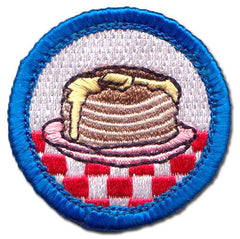
This got me to thinking: What kinds of merit badges would you invent for blogs? The mother of merit badges, of course, is Scouting. Among the existing and legitimate merit badges that might apply to this blog, I found these two, for computers and bicycling.


But wait there's more! The New York Times suggests a merit badge for providing your family with home tech support. Are you keeping your Mom's wifi network running? Kind of locked into it, whether you want to or not? This badge is for you.


The website Nerd Merit Badges offers several merit badges for your purchase, including this merit badge for achieving "Zero Email Bounce", which is the condition of keeping an empty inbox. I strive for ZEB, but my progress to date has left me convinced that it's a journey (ZEB-vana?) rather than a realistic goal.


Nerd Merit Badges also offers a merit badge for "full stack web developers". A full stack web developer is defined by Randy Schmidt as someone that does design, markup, styling, behavior, and programming.


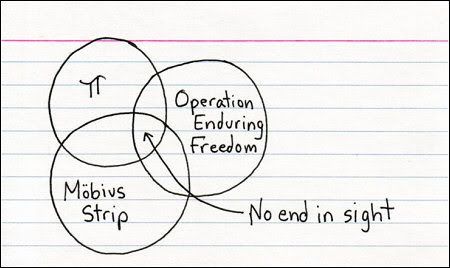
Science Scouts offers a lengthy list of geek merit badges (digital only, but isn't that what we're all about?) for downloading. My favorite right off the bat is the "interdisciplinary merit badge", AKA the "Somewhat confused as to what scientific field I actually belong to" badge. I like to think of it as a Venn Diagram Merit Badge.

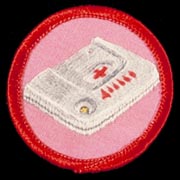
Lest we seem a misogynist, let me point out that artist Mary Yeager has produced series of female-oriented merit badges, including badges for various rites of passage for women. The badge to the right celebrates "at-home pregnancy test". It's a pretty thorough list of merit badges.


Final question: what would a Burgh merit badge be? What would you do to earn it?
October 11, 2009

Elegent Code And Implementation: The Baby Rocker

Linux Baby Rocker


There's elegant code, and there's elegant implementation, and sometimes you get to see them together in the same project.

Here's a bit of elegant code, just 5 lines if you remove the explanatory comments:
while [1 = 1]
   do
        #eject cdrom
        eject

        #pull cdrom tray back in
        eject -t
   done


Here's an abundantly elegant implementation:
June 30, 2009

Facebook Username Landrush Debacle

Recently Facebook allowed people to register "vanity plate URLs" as their usernames. If you wanted and nobody else had claimed it, you could be "JennyDeluxe", or whatever struck your fancy.

At midnight Eastern time, Facebook members could pick user names for their profile URL’s that actually make sense, in place of the previous nonsensical numerical ones. (The numerical addresses look like this — http://blog.facebook.com/blog.php?post=90316352130 — which is also the Facebook page explaining the procedure.) To prevent name-squatting, people will not be able to sell or reassign usernames.


To say that it was a circus is to underestimate the land rush. As the registration system slowed down with the onslaught of requests, and as "not available" responses grew after the first easy claims were staked out, wits realized that Facebook Username can be abberviated "FU" and twitters on #FUFacebook become a trend.


As more and more common names were snatched up, frustration grew and blogs about The Facebook Username Debacle multiplied. Anil Dash blogs,
A white guy named David discovers every variation of his name on Facebook is already taken, realizes he will never get a representative username, and finally reconsiders the condescending contempt he's always had for black people who give their kids unique names. This tiny bit of racial reconsideration is the only unequivocally good news to come out of the Facebook Usernames Debacle.
That is one of the funniest things I've read about geeks and race. Admittedly, it's a narrow focus.


Tuesday: Firefox 3.5 available for download. This was originally called 3.1 a long time ago, but so many changes - most notably a much faster Javascript engine - have been packed into this update, they decided to go to 3.5.
June 23, 2009

Venn Diagrams : A Chart Geek's Favorites

I've heard of Multiple Personality Disorder. If there were such a thing, I'd have Multiple Geek Syndrome (MGS). In fact, I do have MGS, but I prefer to think of it as a feature rather than a bug.

I am many kinds of geek. Info Geek. Bike Geek. Airplane Geek. Map Geek. And: Chart Geek. I really love a good chart. Let's talk charts. One of the types of charts that I like, and that translate well to the general population (a euphemism for non-chart-geeks), are Venn Diagrams.

Charts are symbolic representations of the world. They can describe complex things without many words. Charts are awesome. Sometimes, part of the trick is understanding the implications of the chart design - what it implies, what it denies, etc.


One of my favorite charts types is Venn Diagrams. Venn diagrams are exhaustive in that they show all possible intersections of various sets. Because it is difficult to depict these intersections in two dimensions, Venn's own diagrams only described the relationships of up to four sets, which he used ellipses to depict. This report uses Venn's four-ellipse-set to describe the intersection of the insect and human genome.


Subsequent work has extended Venn diagrams into four, five, and six sets. This includes the work mathematician Charles Dodgson, otherwise known as the writer Lewis Carroll, who depicted a Venn diagram of six sets.


A.W.F. Edwards created symmetrical constructions of Venn diagrams with higher numbers of sets. He projected the Venn diagram onto a sphere, depicted the intersections on the surface of the sphere, and then projected the resulting sets back to the plane to give cogwheel diagrams with increasing numbers of teeth.


Call to Action

I have not come across any photos of Venn diagram tattoos. If you've got one, please send it over. Thanks, Vannevar.


A Mathematician's Memorial

A.W.F. Edwards also designed this stained glass window commemorating John Venn, which is placed in the Hall of Gonville and Caius College at Cambridge University, England.


A Euler Diagram is a further development of Venn Diagrams, but Euler Diagrams are not required to be exhaustive; they do not need to show all possible intersections of sets, and they can show non-intersections as well.


Venn diagrams have moved beyond arcane set theory (as enjoyable and satisfying as that can be) into the sphere (sorry) of art. So let me say that understanding Venn diagrams is something to hope for, possibly even something to pray for:


Best Non-Mathematical Venn Diagram I've Ever Seen


Without further ado, I'd like to introduce the Venn diagram that I saw today, which prompted me to write this post. It's the best Venn Diagram I've ever seen. I really appreciate how he uses the nuance of the various intersections to draw out the suggested strategies.
Best Venn Diagram Ever: How To Be Happy In Business

Knowledge is Justified True Belief

Knowledge is Justified True Belief

This Venn diagram depicts Plato's epistomological assertion that "knowledge is justified true belief".


Make Your Own Venn Diagrams


If you'd like to make your own Venn Diagrams, try Venny, an online Venn-Maker.

Venn Small Amusements

(click for originals, links open in new window)


April 27, 2009

Layer Tennis : A New Geek Sport ?


What is a sport?
Is Fishing a sport? Yes Bowling? Yes
Nascar? No Badminton? Yes
Math: No, although schools have Math Teams.
Coding: No, although we have Extreme Team Coding.

Tennis: Yes, it is a sport.
Layer Tennis, on the other hand... it's an open question.

It used to be called Photoshop Tennis, but then the Corporate Sponsor (Adobe, manufacturer of Creative Suite 4), renamed it to embrace the full power of the <breathe in> integrated suite <breathe out>.

Layer tennis is a competition of revisions. Instead of a ball or a shuttlecock, the players exchange an image file. The first player serves the image to the other, possibly along with some descriptive text. The opposing player has 15 minutes to revise the image by adding a new layer, provide rebuttal text, and return the serve. The game is umpired by the third person, our omniscient narrator who's chosen for his/her geek cred.


The audience (Season Ticket Holders) (get free tickets here) watch the competition online, and then vote for the winner after ten serves.

The next match for this season is this upcoming Friday, May 1, 2009, and they continue throughout the month of May.

Here's a series of images from a Layer Tennis Match between Steven Harrington and Chuck Anderson.

Harrington serves:


Anderson Returns:


Harrington's Last Return:


Anderson's Final Swing:
April 20, 2009

Geek HTML Humor and Tripartite Gaul

geek humor

I'd like to share some geek humor. I'm afraid it needs a bit of an intro.

Geeks write HTML code using tags that go within <brackets>. For instance, if you wanted to make text appears in bold, you'd turn BOLD ON with a tag like <BOLD> and then later you'd turn BOLD OFF with a tag like </BOLD>.

<BOLD> .... lorem ipso ... </BOLD>
Once again, the first tag turns something "on", and the second tag with the slash turns it off again.

You may see that the coder's habit of using tags to mark transitions to and from different perspectives have spilled over into the realm of web comments and email. Instead of the once-trendy emoticons :) we now see emotitags


There are three essential pairs of tags on a web page: HTML, HEAD, and BODY.

<HTML>...</HTML>
The HTML tag goes at the beginning and end of the document, and tells the browser to begin treating it like an HTML file - and to stop treating it like an HTML file at the end of the document.

<HEAD>...</HEAD>
The HEAD section contains information visible to computers - metadata, stylesheets, geek stuff.

<BODY>...</BODY>
The BODY section contains information visible to humans - the content of the website.

So, as my web teacher Dr. Skovira taught me, these three tags define the code just like tripartite Gaul, as shown here:
Geek html humor


Given all that geek backstory, here's the pun:


That was a long way to go, but to a code writer that's just hilarious.


Okay, just one more:
html humor
April 06, 2009

Little Red Riding Hood 2.0 : The Geek Perspective

Here's Little Red Riding Hood 2.0, complete with satellite tracking, product placements, and the general geek perspective:

SlagsmÄlsklubben from Tomas Nilsson on Vimeo.

Little Red Riding Hood is a classic children's story. The story has gone through several variations. In 1697 it was included in a book by Charles Perrault, who explained the 'moral' at the end so that no doubt is left to his intended meaning (a harsh morality tale warning young women about men's intentions):
From this story one learns that children, especially young lasses, pretty, courteous and well-bred, do very wrong to listen to strangers, And it is not an unheard thing if the Wolf is thereby provided with his dinner. I say Wolf, for all wolves are not of the same sort; there is one kind with an amenable disposition — neither noisy, nor hateful, nor angry, but tame, obliging and gentle, following the young maids in the streets, even into their homes. Alas! Who does not know that these gentle wolves are of all such creatures the most dangerous!


Jacob and Wilhelm Grimm (the Brothers Grimm) were told two different versions of the story, and in an 1812 book they presented them both - one as the original story, and the other as the sequel. In the sequel, the Grandmother and Red killed a wolf after learning the nature of wolves in the first story.


There are several mainstream presentations of Little Red Riding Hood, mostly derived from the Grimm Brother's version of the story:


Finally, we have Tex Avery's remake as a bridge between the classic Grimm's version and today's multi-media version. It departs from the Grimm Brother's story line and actually hews closer to Perrault's perspective until it diverges for the comic ending: