FY2011 sets record for military surplus transfers to police departments.

30 Big Corporations Spent More Lobbying Than On Taxes, 2008-10 (via EBM)

Good friends sent good links and I wanted to pass these along.
 We have received feedback that our claim is far-fetched, over-reaching, and myopic. Fortunately, New York City's Mayor
 NYC is ready to go to war.
Mayor Bloomberg boasted yesterday that "I have my own army" in the NYPD and, if that wasn't enough to establish the city as a worldwide power, added "I have my own state department" as well.
The comments came during a speech the mayor delivered at MIT describing how he was managing the city. Trying to offer some idea of the scope of New York's workforce, Bloomberg got a bit carried away with himself.
"I have my own army in the NYPD, which is the seventh largest army in the world," he said. "I have my own state department, to Foggy Bottom's annoyance. We have the UN in New York, so we have entree into the diplomatic world that Washington does not have. I don't listen to Washington very much, which is something they're not thrilled about."
 When a G-20 type event comes to a city, or when law-abiding citizens exercise their constitutional rights of protest and assembly (which, BTW, was kind of what the Revolutionary war was about) it is handled as a military event. The photo shows military officers on the streets of my city during a G-20, when tear gas, stun grenades, and the LRAD sound cannon were used on peaceful citizens.
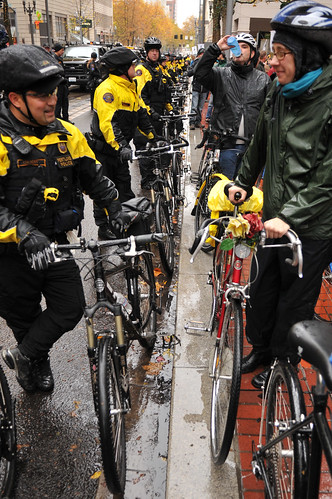 In Portland, Oregon, the police have taken another approach. Here's the Portland headline: Police on bikes meet protestors on bikes: Smiles, dialogue ensue.
  |  |  |
| A Countdown of Sorts: Eight Days and A WakeUp | ||
 |  |  |

| Two questions. | 1. Cui bono? Who profits? It's an evergreen question. 2. Do you know who's talking to your children about their future? |
 There's a concerted effort to convince young people to leave home, shave their hair, take a vow, and embark upon a new lifestyle of hardship, struggle, and not much money. They offer welcome and acceptance into a positive, cohesive culture pursuing a noble calling.


But threats, new in kind or degree, constantly arise. Of these, I mention two only.
Until the latest of our world conflicts, the United States had no armaments industry. American makers of plowshares could, with time and as required, make swords as well. But now we can no longer risk emergency improvisation of national defense. We have been compelled to create a permanent armaments industry of vast proportions. Added to this, three and a half million men and women are directly engaged in the defense establishment. We annually spend on military security alone more than the net income of all United States corporations.
Now this conjunction of an immense military establishment and a large arms industry is new in the American experience. The total influence -- economic, political, even spiritual --is felt in every city, every Statehouse, every office of the Federal government. We recognize the imperative need for this development. Yet we must not fail to comprehend its grave implications. Our toil, resources, and livelihood are all involved. So is the very structure of our society.
In the councils of government, we must guard against the acquisition of unwarranted influence, whether sought or unsought, by the military-industrial complex. The potential for the disastrous rise of misplaced power exists and will persist. We must never let the weight of this combination endanger our liberties or democratic processes. We should take nothing for granted. Only an alert and knowledgeable citizenry can compel the proper meshing of the huge industrial and military machinery of defense with our peaceful methods and goals, so that security and liberty may prosper together.
Akin to, and largely responsible for the sweeping changes in our industrial-military posture, has been the technological revolution during recent decades. In this revolution, research has become central, it also becomes more formalized, complex, and costly. A steadily increasing share is conducted for, by, or at the direction of, the Federal government.
Today, the solitary inventor, tinkering in his shop, has been overshadowed by task forces of scientists in laboratories and testing fields. In the same fashion, the free university, historically the fountainhead of free ideas and scientific discovery, has experienced a revolution in the conduct of research. Partly because of the huge costs involved, a government contract becomes virtually a substitute for intellectual curiosity. For every old blackboard there are now hundreds of new electronic computers. The prospect of domination of the nation's scholars by Federal employment, project allocations, and the power of money is ever present -- and is gravely to be regarded.
Yet, in holding scientific research and discovery in respect, as we should, we must also be alert to the equal and opposite danger that public policy could itself become the captive of a scientific-technological elite.
"General Electric (which owns NBC) is a subcontractor for the Tomahawk cruise missile and Patriot II missile both of which were used extensively during the Persian Gulf War. General Electric also manufactures components for the B-2 stealth bomber and B-52 bomber and the E-3 AWACS aircraft which were also used extensively during the conflict. During Gulf War I, General Electric received $2 billion dollars in defense contractors related to weapons which would be used in Gulf War I and Gulf War II."


 The last week has been reported as a "Twitter Revolution" in Iran. Partisans who do not believe the reported election results are protesting in the streets. There are videos of crowds facing police.
 This protest's new reported gadget is Twitter, with people posting 140-character text messages that answer the question, "What are you doing now?" Fox News reports, Iranian Protesters Cling to Twitter as Key Lifeline Amid Crackdown.
So there are Tweets reporting events. Actually, there are text messages introduced into a network purporting to tell a story. There are multiple groups with a variety of stories they'd like to put in front of the American public. The Twitter network is easily entered, and there's no verification of who's who.Once upon a time, on a winter night, I wanted to teach my son a lesson about critical thinking. He sat with me while I spoofed his school's email server and sent out a note appearing to come from the principal, appearing to go to all the parents, but actually only going to my wife's email.
We sat together, watching my Wife surf the web, and in a few minutes we heard the "you've got mail" chime. She read the email - which said, the boiler's exploded, no school tomorrow, please don't call the school we're trying to keep the line open, we don't have all the email addresses so please call your friends and spread the word". As we watched, my Wife said, hey good news, and reached for the phone to call her buddy Carmella.
We interrupted her and explained that it was just a demonstration. What I wanted to show my son was that you can't believe something just because it's on a screen. Unfortunately, the lesson he took away was how cool it is to spoof an email server. Sigh.
 Some Westerners have tried to support the "tweeters" by hosting a Tor proxy server on their own computers that would disguise an Iranian's IP address. Of course, this also allowed any miscreant who wanted to pose as an Iranian tweeter to boldly proclaim their false message. Other westerners have set their own computer and phone settings to the Tehran time-zone, hoping to produce a flood of Tehran-timed tweets to make the genuine article untrackable. They also have the unintended effect of rendering phony tweets indistinguishable from the real ones.
 |  |
 When question about the capabilities that Nokia-Siemens-Networks has delivered to the Iranian regime, their spokesman said that the company “does have a choice about whether to do business in any country” but said, “We believe providing people, wherever they are, with the ability to communicate is preferable to leaving them without the choice to be heard.” Ahh, George Orwell's Newspeak still lives.
 Current tech news reports that Nokia-Siemens has provided Iran with the technology to track protesters. We should not be shocked; the military-industrial complex is not known for an ideology other than profits. In the run-up to World War II, IBM provided the Nazis with technology to track Jews, and also sold the Nazis systems to keep the trains to the death camps running efficiently.
 CNET writes, Edwin Black's book "IBM and the Holocaust: The Strategic Alliance Between Nazi Germany and America's Most Powerful Corporation" argues that information technology--in the form of IBM's Hollerith punch-card machines--provided the Nazis with a unique and critical tool in their task of cataloguing and dispatching their millions of victims.
 IBM has responded to questions about its relationship with the Nazis largely by characterizing the information as old news. "The fact that Hollerith equipment manufactured by (IBM's German unit) Dehomag was used by the Nazi administration has long been known and is not new information," IBM representative Carol Makovich wrote in an e-mail interview. "This information was published in 1997 in the IEEE Annals of the History of Computing and in 1998 in Washington Jewish Week."
  From the Village Voice: Custom-designed, IBM-produced punch cards, sorted by IBM machines leased to the Nazis, helped organize and manage the initial identification and social expulsion of Jews and others, the confiscation of their property, their ghettoization, their deportation, and, ultimately, even their extermination.
 Posts
All Comments
Posts
All Comments


