Tag Cloud      TLA      About
Sunday, March 28, 2010

Change, Emo Change, and Mass Movements

In my day job I sometimes get involved in change, and change is hard to do well, at least for me. I puzzle over what are the factors that make change difficult. On the other hand, some situations make people (jihadis, for instance) eager to die for change and I wonder what separates these two very different responses. Why is it so hard to implement, for example, a new computer procedure but so easy for a Philadephia single mother to become Jihad Jane and join forces with assassins? What do the Sheiks (or the Nazis, or the Communists) know about managing change that I might benefit from?

In the last few weeks I've finished two books, each dealing with Change in their own way. One was written by a Ph.D., the other by a self-educated longshoreman, and I've enjoyed them both.
In Managing Transitions, William Bridges (Ph.D.) writes about the emotional impact of change and suggests that before people accept change they need to go through the emotional phases of transition: grieving the ending of the previous "normal", a chaotic empty neutral zone, followed by a willingness to come to terms with the "new normal".

Bridges goes on to point out that as the speed of change increases, people are increasingly dealing with multiple changes, each in their own phase - so that rather than dealing with one transitional phase in isolation, people are simultaneously in multiple endings, nuetral zones, and beginnings.

This was an interesting book, I've tended to see it as the "emo-change" book in the way it focuses on the emotional implications of change. It's certainly a balancing read for technoquants who see change management as a merely technical exercise.

While Bridges describes change as something difficult that people are adverse to, the second book discusses how and why people sometimes embrace major changes. In The True Believer, Eric Hoffer discusses the nature of mass movements in which people eagerly seek change.

Eric Hoffer is an interesting study himself. Born into a working class family, he went blind at age seven. When his sight returned at 15, his fear of returning blindness prompted him to read voraciously. He became a migrant worker, living "between the books and the brothels". When called an intellectual, he insisted that he was a longshoreman.

Hoffer's book The True Believer talks about a situation in which people embrace radical change: the mass movement. He analyses the motivations that cause people to seek massive change, and explains that it is people with poor self-esteem that initially support mass movements, and that for them their membership in a movement is more important than the goals of the movement.

Hoffer's book is brilliant. Written in 1951, it explains both al Queda and the Obama presidential campaign. He analyzes the reasons that some seek big change (low self-esteem, frustration, no creative outlet) and the reasons that some people are impervious to movements (high self-esteem, individual identity, a fully formed personality).

He charts the leadership of movements from the men of words, to the fanatics, to the men of action, and finally to the administrators. In Hoffer's book, which is quite non-political, resistance to change is attibuted to people who are people who are fully formed individuals - and apathy to change is attributed to people struggling for survival.

My take-aways from Hoffer's book are (1) marveling at the philosopher and (2) re-appraisal of resistance to change. Perhaps it's a good thing that some people are resistant to change, and perhaps those in that category are among our best people.

Maybe change shouldn't be easy. Maybe initiators should have to justify it, earn it, and work it.
Saturday, March 27, 2010

Tweed Ride Pittsburgh 4/03 at 3pm

Tweed Bike Ride PittsburghPittsburgh's Premier Tweed Ride, Saturday April 3rd, 2010, 3pm.

The Tweed Ride starts at Doughboy Square (the confluence of Penn Ave and Butler St) and continues to Piper’s Pub on the South Side.

Pittsburgh's Tweed Ride is sponsored by ClankWorks (more on them shortly).

What is a Tweed Ride? A Tweed Ride is a bicycle ride featuring riders wearing traditional tweed garments rather than lycra or spandex; the bicycles are often older models; and if we're lucky, someone will bring along a penny-farthing bike.


Tweed rides have recently been seen in San Francisco, DC, and Los Angeles. Here's a photo from the November LA Tweed Ride:
LA Tweed Ride


Photo from the recent Washington DC Tweed Ride:
DC tweed bike ride

This leaves me with two questions:
1. Can I find a tweed sweater?
2. Is there such a thing as black-and-gold Tweed?
Thursday, March 25, 2010

IBM Helps China Censor Texts. Just Business, Just like with the Nazi's

Beijing, which strictly censors the Internet and other media, has launched a crackdown on "illegal short messages", state media has reported.

Let's say you are a Fortune 2000 company. You make software, you sell consulting services, and you dabble in hardware. You're doing well. Here's a hypothetical question:
Communist China offers you $50 million to develop software that can be used to track comments on web forums and to track the sender and receiver of "spam" email. To them, "spam" means anti-government, anti-harmony, the sort of thing that the people should be protected from.
  • Do you sell the government the software?
  • Do you choose to not sell the software?
If you're IBM, you sell them the software.

Tom Watson Would Be Proud


Grandpa would have been proud. This is the same company that sold the Nazi's the information system that automated the Holocaust. From Wikipedia:

IBM's subsidiary Dehomag sold the Third Reich unit record equipment and data processing technology and services. IBM played an integral administrative part in the systematic genocide of the European Jewish community from 1939 to 1944, by helping the Nazis organize and coordinate their efforts toward gathering and organizing all available information about their victims.


Specifically, IBM leased their unit record (punched card) equipment and support services to the Third Reich, providing a significant help in dealing with the massive administrative task that was the 'Final Solution', with sizable profits for IBM. IBM denies that it had control over its subsidiaries after the Nazis took control of them. Researchers such as Edwin Black found that in addition to the Dehomag connection, a large amount of the technology arrived via "a subsidiary in Poland, Watson Business Machines in Warsaw, which reported directly to the IBM New York headquarters."


The poster at the right refers to the "Hollerith" machines that IBM provided the Nazi's. Hollerith was the US census official who developed the punch card, and later founded the company that became IBM.

I really liked Google's decision to cease self-censoring Chinese search results, and I like it a lot more now that I've read about IBM's helping to control the masses (again).
Saturday, March 20, 2010

Google Chrome, Donald Knuth, $1337 and Leetsdale PA

Google has just presented its top prize of $1337 to Sergey Glazunov for identifying a significant security risk in the Chrome Browser.


Google encourages developers to identify security problems with the browser, awarding some with simple acknowledgements and geek bragging rights, while awarding others cash up to $1337 (for “particularly severe or particularly clever” bugs). They've just awarded their first full prize.

Google's incentive program is a homage to Donald Knuth, author of The Art of Computer Programming (TAOCP). Knuth used to pay a finder’s fee of $2.56 for any typographical errors or mistakes discovered in his books, because “256 pennies is one hexadecimal dollar”, and he paid $0.32 for “valuable suggestions”. Given his near-mythic status in geek circles, these checks were valued way above their monetary value; computer scientists with both a PhD and a Knuth check hanging on the wall would sooner take down the PhD. Knuth was crowdsourcing before we had the word (or the web).

Times change, and even honorifics must adapt. Rather than offering a reward of $2.56, which was considered clever as all get out when it was first introduced, Google choose a top award of $1,337.

That amount may not mean much to many, but to younger geeks 1337 is the equivalent of LEET, a sort of geek pig-latin in which numbers substitute for letters in words.
  • 0 can be used for O
  • 1 can be used for I (or L)
  • 2 can be used for Z (or R and Ä)
  • 3 can be used for E
  • 4 can be used for A
  • 5 can be used for S
  • 6 can be used for G (or B)
  • 7 can be used for T (or L)
  • 8 can be used for B
  • 9 can be used for P (or G and Q)

What is particularly interesting to me is that the Pittsburgh region is the home of our very own Leetsdale (or L33tsd4le or even £337$Ð4£3 depending on your denomination). Why there's no annual Leet/1337 Festival escapes me.
Friday, March 19, 2010

1937 Copenhagen Travelogue

This is a 1937 travelogue about Copenhagen. It's very early color film, remarkable footage. At about 6:15 the urban cycling gets excellent.

The movie is a snapshot of its time (as movies are), and reflects the race (in)sensitivity of 1937.


Imagine that ratio of bikes-to-cars in Pittsburgh today. Of course, there'd be no living 40 miles from your job, either.
Thursday, March 18, 2010

Google Fiber in Pittsburgh

Google Fiber in Pittsburgh
Google is going to select a North American city as a testbed for a new high-speed internet network, and Pittsburgh wants to be that city. There's a Post Gazette story, there's a Pittsburgh Google Fiber website, there's even a photo of Mayor Luke with a laptop in the paper:

Google Fiber Pittsburgh
Insert No Child Left Behind Joke Here

It would, of course, be wonderful if Pittsburgh were selected. Somebody did a very nice job on the website. In particular, I love the bottom-of-the-page icon:

Google Fiber in Pittsburgh: We've Reserved A Seat


I really like this. It's got the Pittsburgh parking chair thing going, the colors in the chair are woven through the site, this is just excellent.

Please consider clicking here and nominating Pittsburgh.
(Google account required n'at). (note: link updated)
Wednesday, March 17, 2010

My Life in a Venn Diagram

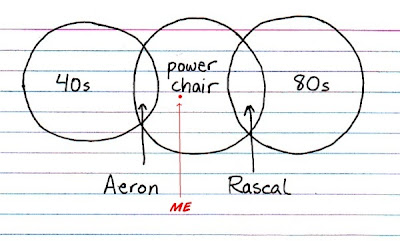
I have written before about my appreciation of Venn Diagrams and all that they imply. This diagram from Indexed seems particularly trenchant:

Life in a Venn Diagram, Power Chair, and Me

So the Aeron space at the intersection of 40's and power chairs refers to Aeron chairs, once a symbol of dot-com cluelessness and arguably the most trendy power-chair for those who accumulate such things. The Rascal Scooter, on the other hand, at the intersection of 80's and power chairs, is an electric scooter for senior citizens.

And I - (I who have an Aeron in my office, and probably a recumbent trike if not an actual Rascal in my future) - I am somewhere on the spectrum, as indicated above, inexorably moving left-to-right, at what seems to be an increasing rate. To have one's life represented in such a manner!
Sunday, March 14, 2010

Alpha, Beta, Gamma Testing at Apple, Toyota, and Boeing

iPadSaturday the floodgates opened and 120,000 people pre-ordered their Apple iPads, which is possibly the worst-named product in recent memory. (One woman journalist immediately exclaimed, "OK, so no women were on the naming panel, I see."
Exactly what they're pre-ordering isn't very well known. The specs that are available were updated just last week. Industry watchers are pretty sure that iPad 1.2 will probably have a USB port, and that iPad 2.0 will be able to multitask (that is, run apps simultaneously). PC Magazine's headline read, "iPad PreOrders for Idiots Only".

This leads to a discussion of the software release cycle, which has been adapted into a product release cycle. The software release cycle evolved from the 1960's IBM product test cycle.

Alpha Beta Gamma Omega testingAlpha Testing is testing done within the company, by people other than the engineers, programmers, and designers who built the product. It usually involves white box techniques, but can include black box and even grey box techniques.

Beta Testing (following Alpha Testing) is user testing within a controlled situation. The product is not released to the market. A "beta version" is the first version released outside the organization or community that develops the product, for the purpose of evaluation or real-world black/grey-box testing.

As the Internet has allowed for rapid and inexpensive distribution of software, and as competitive pressure has decreased time-to-market, companies have begun to take a looser approach to use of the word "beta". Netscape Communications was infamous for releasing alpha versions to the public and calling them "beta" releases. Gmail and Google News have been in beta for years. This technique may also allow a developer to delay offering full support and/or responsibility for remaining issues.

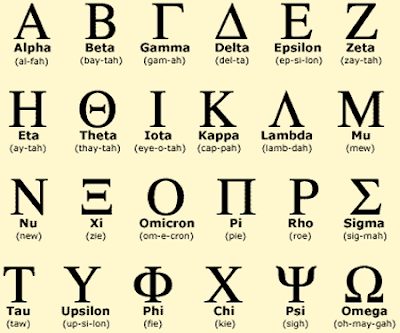
With the ubiquity of the web, a lot of people know about alpha and beta products. There's more than just those two. Gamma testing is the third level of testing, generally for safety. Delta testing is the fourth round of testing, and Omega is the last round of testing. (This is the sequence of letters in the Greek alphabet). Unfortunately, Gamma testing is becoming a thing of the past, killed off by decreased time cycles, competitive pressure, and the myopic focus on quarterly profits.

Apple iPad alpha beta versionSaturday Apple started taking advance orders for the iPad (wifi not 3G), and 120,000 were ordered, sight-unseen, in the first 24 hours. People are willing to pay a premium to be an early-adopter and what is essentially a beta-tester. This in spite of the fact that the people who bought the first iPhone would shortly see an improved, updated version being sold for less.

For $600 you get a WiFi tablet with no camera, no Java, no Flash, no stylus, limited multitasking, and an Apple logo. For $600 you can also get a fully functional netbook. To a degree, such is the cachet of Apple and the major alpha-geek status derived from being the first person at the coffee bar with an iPad.

What's interesting is that Apple is selling a beta-test product to early adopters who are eager to participate in the process. Apple's not the only outfit selling a beta-test product to the public.

In the NY Times, Robert Wright blogs about Toyota and the increased tendency to conduct the "subsequent, de facto beta testing that is also known as 'selling the product and then reading the user forums'." I think the original Big Blue product managers would shudder at using Granny as a Gamma Tester.

In my time, the most egregious public-as-gamma-tester episode was the Boeing 737 rudder charade. There was a clear problem with the product that was not discovered during alpha and beta testing. 204 people died in these accidents between '91 and '94: United 585 (25 lost), Copa 737 (47 lost), USAir 427 (132 lost).

When the end users discovered the problem, the response was to keep the fleet flying (too big to ground) while the rudder hydraulics were reworked and updated. During the time between the discovery and the resolution, every passenger on a 737 was participating in an undeclared test flight. The government's bet in not grounding the fleet worked (in that we didn't have another disaster before the rudders were reworked) but IMO it was a terrible, cynical decision.

If the people pre-ordering iPads are happy to pay to be beta-testers, that's all good. But if they think they're buying a ready-for-market product, they're suckers.
Saturday, March 13, 2010

Delta's PIT - CDG flight draws full $5M subsidy

Excellent post at NullSpace regarding Delta's direct flight, PIT to Paris.

The Pittsburgh Business Journal reports that the Allegheny Conference will have to pay the full $5 million subsidy to compensate for revenue shortfalls.

The agreement between the Allegheny Conference and Delta is a two-year contract stating that if the flight doesn’t reach a revenue threshold, the Conference will pay the airline up to $5 million during year one, and up to $4 million during year two.

  • The average load factor over the first eight months was 68 percent. Delta’s average load factor for transatlantic flights between June and January 2009 was 83.6 percent.

  • What the Conference projected as a $582 average one-way fare for a trip from Pittsburgh to Paris turned out to be an average $412 rate in 3Q 2009.

  • With about 407 daily passengers traveling internationally at PIT during the third quarter of 2009, about 88 of those utilized the Paris-Pittsburgh flight.

  • Two Indian cities — Mumbai and Bangalore — are among the top 10 destinations of the Pittsburgh-Paris flight’s travelers.


My take-away is this reflects a government inability to affect the marketplace. In a way, the Allegheny Conference subsidy contract was a non-government (NGO) stimulus to jump-start international service at the airport. After one year, it doesn't seem to be working. Maybe it's too soon to tell.

Or maybe it's a leading indicator for our other, larger government stimulus programs.
Thursday, March 11, 2010

Google Bike Maps - Pittsburgh to Boston Trailhead

Google has announced that their Google Maps application now attempts to provide bike routes. The routing algorithm prefers to use bike paths, lanes, and sharrows, and attempts to avoid hills and highways.

This is great. I asked it for a route from Pittsburgh PA to Washington DC and it routed me via the Great Allegheny Passage and the C&O Canal.
Google bike map, Pittsburgh to DC

Among bicyclists familiar with riding from Pittsburgh to DC, perhaps no other topic is as continually energetic as, "What is the best way to get from The Point to the trail in McKeesport-Boston?"
  • There is the Ft Pitt bridge, Station Square to Baldwin Trail, ~andcastle, and then 837 past Kennywood to the West Mifflin trailhead group.
    • There's a Jail Trail, Hot Metal Bridge, Baldwin Trail variation.
  • There is the Second Avenue, Glenwood Bridge, 885 to 837, Kennywood, West Mifflin contingent.
  • Finally, there's the schism group that believes it's irresponsible to advise any transient cyclist to ride north of Boston. (that's my denomination)
This discussion generates more passion than Helmet Wars and even the Recumbent Question. I thought it would be interesting to see which path Google picked from the Point to the trail in McKeesport or Boston. It choose this:
bike map, Pittsburgh Point to McKeesport or Boston bike trail

This is intriguing - Google choose the Second Avenue route out of downtown, followed by an unexpected direct (and hilly) route from the Glenwood Bridge to Boston PA. It works, and it's lower traffic than 837, but it'd be a lot of work on a bike loaded with panniers.

My review of Google Bike Maps: It's not as good as knowledge of the local area, but if you're unfamiliar and trying to plot a route it'll be a worthwhile tool. It would be wonderful if you could export the Google route into a Garmin GPS for on-bike navigation, but I realize that they're selling 'Droid phones so the GPS export probably isn't likely.

Update (courtesy of Mike from the GAP Yahoo Group): there's a third-party Google-Maps to GPX exporter at: http://www.elsewhere.org/journal/gmaptogpx/.

Sunday, March 07, 2010

Take Your Child To Work Day: April 22nd

In this week's news we've seen a lot of discussion about taking your kid to work and showing them what you do, and even giving them a little bit of experience at it.

As this 1968 documentary from the REMCO Corporation shows, kids have been training to work at Kennedy Airport for at least 42 years:


Needless to say, the tone of this year's Bring Your Kid to Work Day (BYK2WD) is probably going to be slightly different. Mark your calendars, Thursday April 22nd.