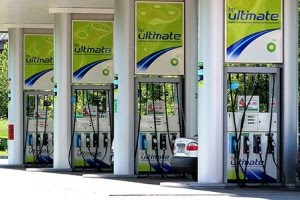
 I have waited to see a backlash against BP for ruining the Gulf Of Mexico, and I expected that by now we'd be seeing a quixotic consumer boycott. I'm surprised to find BP gas stations filled with happy eager customers over the long weekend.
Maybe they haven't made the connection between BP oil platforms and the green-and-flowery BP gas pumps. Maybe that's one of our problems.
 |  |
There seemed to be a similar cognitive dissonance about supply and demand, lifestyle and disaster when 29 coal miners were recently killed at the Upper Big Branch Mine. We don't seem to make the connection.
For the record, I'd like to clarify that IANAD (I am not a Democrat) NTTAWWT (not that there's anything wrong with that). But if I were a Democrat, it would be because of Democrats like Harry Truman, Daniel Moynihan, and Robert Reich.
In his blog today, Robert Reich provides five cogent reasons for President Obama putting BP under temporary federal receivership.
If we can take over AIG and General Motors because of the risk that current management and their actions have posed to the national economy, can't the Federal Government take over BP for ruining the Gulf of Mexico, thwarting development of domestic oilfields, and causing actual damage to the economy?1. We are not getting the truth from BP. Government must be clearly in charge of getting all the facts, not waiting for what BP decides to disclose and when.
2. We have no way to be sure BP is devoting enough resources to stopping the gusher. BP is now saying it has no immediate way to stop up the well until August. August? If government were in direct control of BP’s North American assets, it would be able to devote whatever of those assets are necessary to stopping up the well right away.
3. BP’s new strategy for stopping the gusher is highly risky. Scientists say that could result in 20 percent more oil gushing from the well. At least under government receivership, objective officials would be directly accountable for weighing the advantages and disadvantages of such a strategy.
4. Right now, the U.S. government has no authority to force BP to adopt a different strategy or over the disaster scene. Carol Browner said, “We told (BP) of our very, very grave concerns” about risks. Expressing grave concerns is not enough. The President needs legal authority to order BP to protect the United States.
5. The President is not legally in charge. As long as BP is not under the direct control of the government he has no direct line of authority, and responsibility is totally confused. There is no good reason why “they” are in charge of an operation of which “we” are hoping for the best and preparing for the worst.
Reich concludes by saying, "No president would allow a nuclear reactor owned by a private for-profit company to melt down in the United States while remaining under the direct control of that company. The meltdown in the Gulf is the environmental equivalent."
Robert Reich rocks.


 Ever since I watched the 1990 film


 For example, the “Thin Man,” who in the standard version appears to be a glorified butler to the city’s all-powerful founder, turns out instead to be a much more sinister figure, a combination of spy and detective. The founder’s personal assistant, who is fired in an early scene, also plays a greater role, helping the founder’s idealistic son navigate his way through the proletarian underworld.
 When I think about football players, I think about Steeler


 The phrase Overton Window is about to have its fifteen minutes of fame, as it is the title of
  Here's the problem, visually. You have a single population (the United States) drawn in red, and the Overton Window of acceptable public discourse shown in grey. The objective of the (marketer, consultant, propagandist) is to get the peak to skew to the right/left by delivering relatively extreme messages on that side of the spectrum, having the effect of making the desired change seem reasonable.
 But if the (marketers, consultants, propagandists) of both sides only speak to their own consituency, the one population splits into two populations, which each skew according to their preferences. As the two distributions diverge, the average remains the same, and the Overton Window stays in place, but very few people are in it - most people move outside of the range of civic discourse.
 Posts
Posts

