Showing posts with label memex. Show all posts
December 31, 2010

Out {OLD}, In {NEW}

People do different things on the occasion of a New Year. Get the tax paperwork together. Put new batteries in the smoke detector. Ride Icycle Bicycle (REI, 1100). Update your Memex bookmarks. Gather with friends at 11pm.

This is my 2010-2011 visual metaphor for "out with the old, in with the new".


It's time to send my well-worn, scuffed up 2010 bicycle water bottles to the recycling center and replace them with fresh new bidons. < cynic >(IF the people in that nice blue truck actually take them to a recycling center and don't just bury them in a landfill because it's cheaper/ easier/ greener.)< /cynic >

I prefer translucent bottles, but my Local Bike Shop (LBS) had white and I think it's important to support your LBS. My LBS is the Ambridge Bike Shop, truly great people there.


I'd feel like an adulterer riding around with water bottles from another bike shop. (or at least, what I'd imagine an adulterer would feel like). But if I were going to stray with a non-LBS water bottle, it would probably be either a CleanBottle or one of these listing Velocio's Seven Commandments. So I'm not too virtuous; I'm staying true but I'm also keeping an eye on the options.


Also, on this very last day of the year I've ridden my 2010 goal of 2000 miles.

It's not a very big number, and a lot of people do an awful lot more, but it was a good goal for me, this year.


Happy New Year.
May 15, 2010

God is an Iron. ??


Vannevar Bush wrote that a person's tracks through the Memex of accumulated information would be valuable, and that a father might pass his record of these links down to his children as things of significance. And so I feel like I should identify the track of links that led me to this quote of Spider Robinson: God is an iron.

I was reading the excellent GetTheFlick blog, which referred to a book called Squawk 1200: A History of the Next Midair Collision by Paul Niquette in which Dr. Niquette relates his role in the history of aircraft transponders, Mode C, and TCAS (TCAS is one of the very few {or very first} operational places where we put the machines unilaterally in charge of the humans.)

Dr. Niquette tells about Eastern 375, a flight he hoped to take out of Boston in 1960. His secretary failed to confirm his reservation so he was placed at #8 on standby. He struck up a conversation with a traveller who was #9 on the standby list. It seemed as if the flight would depart without ever boarding standby #8, so Dr. Niquette walked away from the boarding area and spent the night at a hotel.

The next day's headlines were filled with the crash of Eastern 375 due to multiple bird strikes on departure. Pictures of the wreckage showed two dead passengers still strapped into their seats; one of them was the man who was #9 on standby - in other words, if Niquette had been more patient, he would have been dead.

Dr. Niquette writes, "One privilege I have enjoyed over the years is working with bright, insightful people. Kevin is all of that. And a bit mystical. I told him about my encounter with Eastern Flight 375. He listened intently. "God is an iron," he said."

I read that line and I could not make any sense of it. I re-read the chapter and I still did not get it. So I Googled "God is an Iron" and found this:
“If a person who indulges in gluttony is a glutton,
and a person who commits a felony is a felon,
then God is an iron.
” - Spider Robinson
I think Vannevar was right, the connections are important.
January 01, 2009

Out With the Old Bookmarks, In with the New Bookmarks

Ah, New Years Day, with a whole year stretched out in front of us as tabula rasa. People mark the occasion differently. Some people jump in the Mon. Some people ride their bikes. Me, I re-organize my Bookmarks in my browser.

This blog's namesake, Vannevar Bush wrote an article, As We May Think in The Atlantic Monthly in July 1945 speculating about where all our technology would take us. He described a machine called the Memex, which was a hyperlinked information system and the conceptual forerunner of the World Wide Web.

Bush connected numerous existing technologies, projected reasonable advances, and described an information system based on "associative indexing", where you could read one article of interest and have connections developed automatically and instantly. He thought that people would mark up significant finds, add comments, and contribute their own thoughts and conculsions. He was Web2.0 before there was Web1.0.

Vannevar Bush predicted that the "trails" between these documents would be significant, and would be recorded and retrievable by the device. Speaking of mankind, Bush wrote:
He has built a civilization so complex that he needs to mechanize his records more fully if he is to push his experiment to its logical conclusion and not merely become bogged down part way there by overtaxing his limited memory. His excursions may be more enjoyable if he can reacquire the privilege of forgetting the manifold things he does not need to have immediately at hand, with some assurance that he can find them again if they prove important.

Bush said that the record of trails might be passed down from as an inheritance, and I found that to be a significant notion. So I categorize my bookmarks by year and topic. Each year I start a new set of bookmarks, moving the previous year's folders into a "2008" meta-folder. Each new computer I've moved through gets the previous bookmarks. It's a reading list of where I've been. I don't know that it'll be of any value, but if might be interesting and it's certainly not expensive to maintain.

Bush wasn't right about everything. His memex, for instance, was an optical rather than a digital repository, and the record was stored locally rather than on a network. His words provide rich evidence of the gender and class assumptions of a patrician society. But He described the web in 1945, and described it as part of the hope of mankind, and he came out of the war mentality with positive hope for the future. A man could do worse. Few have done better.

So today, I lift a grateful thought to Vannevar Bush and start a set of bookmark folders based on year and topic - 2009 Me, 2009 kids, 2009 news, 2009 blogs, 2009 web design, 2009 programming, 2009 aviation, 2009 Pittsburgh, 2009 bike trips, etc - and start populating a new record of this year's resources.
August 03, 1981

About : Explaining This Blog

Welcome to, What Would Vannevar Bush Blog?
Please contact me here.

Vannevar Bush was the United States' Chief Scientist during WW2. He didn't do a lot of personal invention and discovery during the war, but he led and directed all our scientific efforts.

Remember that at that time, the nation was a research, innovation, and production juggernaut. The fight for survival was a contest of armies, but also a race of science and invention. Who made the best weapons, and could produce the most of them? Radios, radar, atom bombs, rockets, synthetics, navigation - that was the stuff of the war effort.

In 1945, Vannevar Bush was asked "where does this all go next?" For his answer, Bush wrote an article, "As We May Think" for The Atlantic Monthly about where we might go next, and he described an information machine called the Memex.

The article is here, and it's essential reading for anybody who wants to participate in our modern information society. We tend to think that computers were developed in 1980 and that the internet was invented in 1996, but neither is true. Vannevar Bush's notion of the Memex is partially realized in the Web, but we have a ways to go. Also, you can generally win any geek discussion with a person who hasn't read the article by saying, "Well, you know what Vannevar Bush said about that..."

Taking on the "Nothing is really new under the sun" perspective, I wonder "What Would Vannevar Bush Blog" today? I don't claim to have his mind, but I think it's appropriate to give a tip of the chapeau to the man that started it all -- and that isn't Bill Gates or Steve Jobs.

A few details --
  • I'm trying to stop using the word "but", so you'll see that I strikeout that word whenever I use it to stigmatize my bad habit.
  • I was very impressed by the literary use of hypertext in Click by John Barth, also in Atlantic Monthly. This was a remarkable article in the way it suggested the use of hyperlinks as a plot device. It was more remarkable in that it presented underlined links in the text in a paper magazine, and I think it reads better in paper than online. So I try to include that level of embedded links in my writing, and I if it leads you astray I hope you find interesting places.
  • I was also impressed by John Updike's typesetting character Rabbit Angstrom, in his use of rejected text in the linotype machine to indicate what he was thinking. You'll see some of that here, even though the STRIKE style is deprecated.
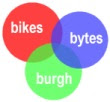
  • I'm a Pittsburgh guy, I'm a geek, and I'm a sometimes bicycle rider, so my sub-headline could be "Bikes, Bytes, and Burgh". Bikes, Bytes, Burgh

  • Generally, links on this blog will open in a new window, and I try to be persistent in reminding you of that with TITLE/ALT tags.
  • When I revise or edit something previously published, I will insert (edited) at the end of the section, in an attempt at playing fair.