Showing posts with label ww2. Show all posts
January 07, 2012

Memory and Perspective: Civil War, Pearl Harbor, Iraq

We have written before of the importance of memory, relying on "The struggle of man against power is the struggle of memory against forgetting" as a shibboleth.

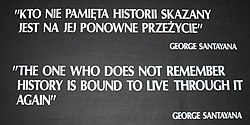
Today we would like to expand the discussion of memory as essential to progress, and start off with American pragmatist George Santayana's "The One who does not remember history is bound to live through it again", shown as an inscription at Auschwitz.


First, we highly recommend Ta-Nehisi Coates' article in the Atlantic, Why do so few blacks study the civil war?

In my opinion it's a landmark document. It's a pleasure to see a good person's oeuvre distilled into a single work that has the potential to change the culture.
Coates establishes slavery, explicit in the South but also exploited by the North, as the cause of the Civil War, and repositions the conflict as possibly the consummation of the Revolutionary War rather than it's current place as the war that white people all feel bad about.


Second, we suggest Robert Wright's "Ron Paul Vindicated (Unfortunately):
A week ago Ron Paul tried to convey how the ever-tightening sanctions on Iran--which may soon include an embargo on its oil--look from an Iranian point of view: It's as if China were to blockade the Gulf of Mexico, he said--"an act of war".

This is sheer conjecture; Ron Paul is no expert on Iran. But now someone who does have relevant credentials has weighed in, and the picture he paints is disturbingly reminiscent of the one Paul painted. It suggests we may be closer to war than most people realize.


That piece leads to Vali Nasr's article in Bloomberg, "Hard-line U.S. Policy Tips Iran Toward Belligerence".
Tensions between Iran and the U.S. are so high, a conflagration could be tripped off without either country intending it. This latest spiral of hostility began after the U.S. and its European allies responded to the International Atomic Energy Agency’s report on Iran’s nuclear activities by imposing and threatening additional, tougher sanctions. New U.S. measures may drastically cut Iran’s oil revenue.

To escape this self-defeating outcome, the Western powers should imagine how the situation looks from Tehran.


Robert Wright picks up on Vali Nasr's suggestion, and imagines how it looks from Tehran:
Iran's nuclear scientists have recently evinced a tendency to get assassinated, and a mysterious explosion at a military facility happened to kill the general in charge of Iran's missile program. These things were almost certainly done by Israel, possibly with American support. If you were Iranian, would you consider assassinations on your soil grounds for attacking the suspected perpetrators?

Underlying our Iran strategy is the assumption that if we keep ratcheting up the pressure, the regime will eventually say uncle. A problem with this premise is that throughout human history rulers have shown an aversion to being seen by their people as surrendering. Indeed, when you face dissent, as the Iranian regime does, there's actually a certain appeal to confronting an external threat, since confrontation tends to consolidate domestic support. As Nasr puts it, "the ruling clerics are responding with shows of strength to boost solidarity at home."

This doesn't mean Iran's rulers haven't wanted to make a deal. But it does mean the deal would have to leave these rulers with a domestically plausible claim to have benefited from it, and it also means these leaders can't afford to be seen begging for the deal. When President Ahmadinejad visited New York last year, he gave reporters unmistakable signals that he wanted to negotiate, but the Obama administration chose to ignore them. After Ahmadinejad "went home empty handed," reports Nasr, power increasingly shifted to Iranians who argued for confrontation over diplomacy.

Even so, Iran's foreign minister made another appeal to re-open talks only days ago, suggesting that they be held in Turkey. But, as the New York Times reported, western nations interpreted this overture "as an effort by Iran to buy time to continue its program." Got that? If Iranians refuse to negotiate it means they don't want a deal, and if they ask to negotiate it means they don't want a deal.

Nasr says the tightening of the screws is making Iran increasingly determined to get nuclear weapons--not to start a war, but to prevent one. Having seen what happened to Muammar Qaddafi, says Nasr, Iran's leaders worry that foreign powers would "feel safe enough to interfere in the affairs of a non-nuclear-armed state."


And so we go back to Santayana, remembering that while the Japanese attack on the United States at Pearl Harbor was precipitated by many things, the final straw that moved plans into action was the US freezing all Japanese assets and Roosevelt's imposition of an oil embargo in July 1941. Which is pretty much what we're doing with Iran right now.

This is how a Japanese pilot saw Pearl Harbor in December 1941:


We can try to see their side first, and work for our goals within that understanding, or maybe we can eventually see what it looks like to them from their combat cameras.
March 27, 2011

The Habituation of Routinized War and the Return of the Draft


There are wars that Americans felt good about in that they were considered just and right. These appropriate wars where the wars that somebody else started, where they attacked us and we declared war against them. WW1, WW2: you can quibble about who knew what/when, and the extent to which we built the provocative scenario, but they were understood as responses to an attack. Americans willingly sacrificed their children and their treasure for those kinds of war.

During the second half of the 20th century, and particularly in the context of the Cold War, a tenet of American military policy was the "second strike" - the United States wouldn't make the initial attack (the first strike), but we would be completely ready for the second strike. Nobody talks about second-strike capability any more. Second Strike is so 1992.

The First-Strike Paradigm

These days we don't attack countries that attacked us first (because countries don't attack us; only small groups of fanatics attack us). We attack other countries because we want to; these are optional wars that we choose to make.

Proficiency at Starting Wars

Proficiency means that things get easier, and your performance improves, the more you do something. We've gotten very proficient at starting wars. Starting wars must be much easier than ending wars, because we've started several lately and we haven't ended any. The Dept. of Defense is in at least three wars right now; the CIA has got one going in Pakistan, too.

We don't declare war any more, or at least we don't do it by the book. We're bipartisan in this willful disregard of the Constitution. Being attacked is no longer a prerequisite for starting a war, and neither is Congressional declaration; we've become clever, we're into War 2.0, and we've developed new excuses justifications for starting a war. Don't fetishize the old ways.

Prophylactic War The opportunistic use of 9/11 as justification for extension of American hegemony moved America from second-strike to first-strike, justified by the dubious philosophies of preventive war or preemptive war
*
: we don't need to wait for mushroom clouds over American soil; bring it. The hubris of George w. Bush / Dick Cheney / Donald Rumsfeld / Paul Wolfowitz was that we could do this surgically, quickly, and with a downsized force.

Humanitarian War As President Obama remarked in his 2009 Nobel Peace Prize speech: “I believe that force can be justified on humanitarian grounds, as it was in the Balkans, or in other places that have been scarred by war. Inaction tears at our conscience and can lead to more costly intervention later. That’s why all responsible nations must embrace the role that militaries with a clear mandate can play to keep the peace.”

The Daily Globe and Mail explains today's philosophy of humanitarian war:
This doctrine is known as the “responsibility to protect” (R2P or RtoP) and was endorsed by the United Nations in 2005. It mandates that the “international community” is morally obliged to defend people who are in danger of massive human-rights violations. R2P is the moral underpinning of the war in Libya, and it’s the reason why people have been so amazingly eager for us to rush into battle.
The hubris of Barrack Obama / Hillary Clinton / Samantha Power / Susan Rice was that we could do this surgically, quickly, and without boots on the ground. At the United Nations, RtoP is considered an achievement of Kofi Annan which is embraced by Ban Ki Moon.

The 1.5 Political Parties

In a blog post today, EBM points out that there's not a significant difference between America's "1.5 political parties", and she's quite right. Consider the similarities between the wars of our last two Presidencies:

U.S. Senator Chuck Hagel (R-Neb) writes,
"So why did we invade Iraq? I believe it was the triumph of the so-called
neo-con
ideology, as well as Bush administration arrogance and incompetence that took America into this war of choice. . . . They obviously made a convincing case to a president with very limited national security and foreign policy experience. . . "

Take Hagel's statement, change the names, and see if it's still valid:
"So why did we invade Libya? I believe it was the triumph of the so-called
neo-lib
ideology, as well as Obama administration arrogance and incompetence that took America into this war of choice. . . . They obviously made a convincing case to a president with very limited national security and foreign policy experience. . . "

Routinized War

Mickey Kaus writes,
In a true empire – in this case, the empire of UN approved human rights enforcement – war never really ends. Always someone to protect somewhere. Imagine living in imperial Britain in the mid-19th century. There would almost always be a war or police action – actual shooting and killing – going on.

For a true empire to work – even, or perhaps especially, a humanitarian empire – war has to be routinized. You’ve got two wars going already? No need to change the president’s schedule to start a third war. Tour Latin America. Talk about your NCAA brackets. Don’t give a big speech – I mean, you don’t call a press conference every time the police run a sobriety checkpoint, do you?

Habituation

We have become habituated to a state of continual warfare, our corporations have adjusted to the money stream, and our institutions have realigned their objectives and budgets to ensure their continuation for the foreseeable future. Habituation turns a goat-roping exercise into the new normal.

The military-industrial complex is motivated to encourage this habituation. What makes habituation more effective?
Two factors that can influence habituation include the interstimulus interval (ISI), or the amount of time between each successive presentation of the stimulus, and the stimulus duration, or the length of time the stimulus is presented. Shorter ISIs and longer durations increase habituation; longer ISIs and shorter durations decrease habituation.
We can expect more undeclared wars, occurring with shorter intervals and of increasing duration. Just saying.


How old is an American kid who remembers peace?

A sixteen-year-old probably remembers when the United States was at peace. In a few more years, that cohort will be nineteen years old. Then the draft-age kids will be 18, their country will have been at war since they were born, and it'll be just like the Oceania vs Eurasia vs Eastasia War.

I thought Charles Rangel was grandstanding when he called for compulsory conscription, but I see now that the Korean War infantryman
*
was exactly right. You ask a kid about the draft these days, and they're going to reply, "NBA or NFL?"

Mickey Kaus says the same thing in his post:
It helps achieve routinization if wars can be conducted by a distinct cast of professionals whom we hire to do the job, as opposed to ordinary citizens who are drafted. That way when soldiers start dying … well, that’s the business they have chosen, right?

And they’re largely drawn from a distinct geographic region, the South. Mothers don’t have to worry that their sons will sent to fight against their will, as happened in Vietnam – and if they’re Northern mothers in well-off suburbs they may not even know anyone who has a family member at risk.


Reintroduction of the Draft

What are the dynamics that might reverse this trend?
  • Significant loss of American military personnel
  • reintroduction of cumpulsory conscription
  • Overextension and economic collapse (oops)
  • an unforeseeable event that provides entry for a new political movement
  • development of a domestic antiwar movement


If not a full reintroduction of the draft, we could at least restore the Draft Lottery. Let enough mothers know that their sons have low draft numbers, and all of a sudden war won't be routine anymore.

And yes, my children are eligible or about to become eligibile for the draft.