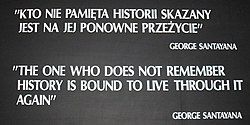
 Today we would like to expand the discussion of memory as essential to progress, and start off with American pragmatist George Santayana's "The One who does not remember history is bound to live through it again", shown as an inscription at Auschwitz.
First, we highly recommend Ta-Nehisi Coates' article in the Atlantic, Why do so few blacks study the civil war?
In my opinion it's a landmark document. It's a pleasure to see a good person's oeuvre distilled into a single work that has the potential to change the culture.
Coates establishes slavery, explicit in the South but also exploited by the North, as the cause of the Civil War, and repositions the conflict as possibly the consummation of the Revolutionary War rather than it's current place as the war that white people all feel bad about.
Second, we suggest Robert Wright's "Ron Paul Vindicated (Unfortunately):
A week ago Ron Paul tried to convey how the ever-tightening sanctions on Iran--which may soon include an embargo on its oil--look from an Iranian point of view: It's as if China were to blockade the Gulf of Mexico, he said--"an act of war".
This is sheer conjecture; Ron Paul is no expert on Iran. But now someone who does have relevant credentials has weighed in, and the picture he paints is disturbingly reminiscent of the one Paul painted. It suggests we may be closer to war than most people realize.
That piece leads to Vali Nasr's article in Bloomberg, "Hard-line U.S. Policy Tips Iran Toward Belligerence".
Tensions between Iran and the U.S. are so high, a conflagration could be tripped off without either country intending it. This latest spiral of hostility began after the U.S. and its European allies responded to the International Atomic Energy Agency’s report on Iran’s nuclear activities by imposing and threatening additional, tougher sanctions. New U.S. measures may drastically cut Iran’s oil revenue.
To escape this self-defeating outcome, the Western powers should imagine how the situation looks from Tehran.
Robert Wright picks up on Vali Nasr's suggestion, and imagines how it looks from Tehran:
Iran's nuclear scientists have recently evinced a tendency to get assassinated, and a mysterious explosion at a military facility happened to kill the general in charge of Iran's missile program. These things were almost certainly done by Israel, possibly with American support. If you were Iranian, would you consider assassinations on your soil grounds for attacking the suspected perpetrators?
Underlying our Iran strategy is the assumption that if we keep ratcheting up the pressure, the regime will eventually say uncle. A problem with this premise is that throughout human history rulers have shown an aversion to being seen by their people as surrendering. Indeed, when you face dissent, as the Iranian regime does, there's actually a certain appeal to confronting an external threat, since confrontation tends to consolidate domestic support. As Nasr puts it, "the ruling clerics are responding with shows of strength to boost solidarity at home."
This doesn't mean Iran's rulers haven't wanted to make a deal. But it does mean the deal would have to leave these rulers with a domestically plausible claim to have benefited from it, and it also means these leaders can't afford to be seen begging for the deal. When President Ahmadinejad visited New York last year, he gave reporters unmistakable signals that he wanted to negotiate, but the Obama administration chose to ignore them. After Ahmadinejad "went home empty handed," reports Nasr, power increasingly shifted to Iranians who argued for confrontation over diplomacy.
Even so, Iran's foreign minister made another appeal to re-open talks only days ago, suggesting that they be held in Turkey. But, as the New York Times reported, western nations interpreted this overture "as an effort by Iran to buy time to continue its program." Got that? If Iranians refuse to negotiate it means they don't want a deal, and if they ask to negotiate it means they don't want a deal.
Nasr says the tightening of the screws is making Iran increasingly determined to get nuclear weapons--not to start a war, but to prevent one. Having seen what happened to Muammar Qaddafi, says Nasr, Iran's leaders worry that foreign powers would "feel safe enough to interfere in the affairs of a non-nuclear-armed state."
And so we go back to Santayana, remembering that while the Japanese attack on the United States at Pearl Harbor was precipitated by many things, the final straw that moved plans into action was the US freezing all Japanese assets and Roosevelt's imposition of an oil embargo in July 1941. Which is pretty much what we're doing with Iran right now.
This is how a Japanese pilot saw Pearl Harbor in December 1941:

We can try to see their side first, and work for our goals within that understanding, or maybe we can eventually see what it looks like to them from their combat cameras.


 I went to the local paper, The Pittsburgh Post Gazette — whoa, did I say I went to the local paper? Sorry, I went to their website, which I suppose is part of the problem newspapers face nowadays — people go to the website for free instead of the newstand. But I digress.
 I went back to P-G.com's
  ravenstahl Lemieux : nothing

 This is a puzzle for me, and if anybody has any comments about what's up I'd love to hear them. Also, if you find other PostGazette search terms that should produce local news about Hizzoner but don't, please kick in a comment. If any P-G folks would like to weigh in, I'm open to feedback and correction.

 Posts
Posts

