June 29, 2011

Bicycle Heaven, Manchester Bike Museum, Opens This Saturday


Marty Levine reports in the Post-Gazette that Bicycle Heaven, a museum of rare and collectible bicycles, opens this Saturday at 10am in the Manchester neighborhood on Pittsburgh's NorthSide.

Craig Morrow, the proprietor, has been collected bicycles and selling collectible bicycles vie Ebay for year, keeping the most interesting bikes for his own collection. His museum will have over 900 bicycles.
June 28, 2011

Fracking Weltanschauungs; Poor New York Missed Out

When information presents a blizzard, it's important to have multiple sources of information and to have some context in which to frame those sources.

The New York Times writes about the fracking industry: Insiders Sound an Alarm. The article presents GMail strings from industry insiders arguing that Marcellus Shale is the Next Big Bubble and that it is both a gas bubble and also another real estate bubble.

“Money is pouring in” from investors even though shale gas is “inherently unprofitable,” an analyst from PNC Wealth Management, an investment company, wrote to a contractor in a February e-mail. “Reminds you of dot-coms.”

“The word in the world of independents is that the shale plays are just giant Ponzi schemes and the economics just do not work,” an analyst from IHS Drilling Data, an energy research company, wrote.


The Wall Street Journal presents The Facts About Fracking, and from their perspective it's all good.

Yes, there are some complaints that fracking has polluted drinking water with methane gas. The story explains, "Methane is naturally occurring and isn't by itself harmful in drinking water, though it can explode at high concentrations." The stories of Pennsylvania residents who are able to set their tapwater on fire are apparently outliers and not statistically significant.

As a regulatory model, consider Pennsylvania. Recently departed Governor Ed Rendell is a Democrat, and as the shale boom progressed he worked with industry and regulators to develop a flexible regulatory environment that could keep pace with a rapidly growing industry. As questions arose about well casings, for instance, Pennsylvania imposed new casing and performance requirements. The state has also increased fees for processing shale permits, which has allowed it to hire more inspectors and permitting staff.

New York, by contrast, has missed the shale play by imposing a moratorium on fracking. The new state Attorney General, Eric Schneiderman, recently sued the federal government to require an extensive environmental review of the entire Delaware River Basin. Meanwhile, the EPA is elbowing its way into the fracking debate, studying the impact on drinking water, animals and "environmental justice."


There is no commonality between the two Weltanschauungs presented; you would think the WSJ and the NYT are from different planets.

It's not the basis for good decision making or good democracy.
June 23, 2011

Edward Tufte's Sense of the Relevant

from today's Washington Post:

Edward Tufte, an authority on analytic design and author of The Visual Display of Quantitative Information, talks to The Washington Post's On Leadership editor Lillian Cunningham about realizing 95 percent of information is junk--and how that has sharpened his approach to any new field he pursues.


June 21, 2011

Pittsburgh's GNC Gets a Whiff of Weakness from LiveStrong and Lance Armstrong

Any resemblance to Jerry Lewis back in the day is in your head, even if they're both big in France.


There's an old story about a Middle Eastern family, and I've been unable to establish its provenance. It goes like this:
The patriarch of a small family was becoming old and frail. His children were worried about him, so they started preparing a special chicken for him to eat. They fed the chicken grain and corn and helped it become fat, so that their father might eat the chicken and the chicken soup and regain his strength.

The local ruffians saw the family's efforts. When the chicken was at its plumpest, just before it was to be butchered, the scoundrels stole the chicken and ate it themselves.

The patriarch's children were angry, and the sons wanted to confront the blackguards and demand payment. But the weak old man said No, just leave it alone, it'll be OK.

The oldest son wouldn't listen, and he confronted the man he knew was the thief. The thief and his cohort beat the son and left him in a heap on the family's doorstep.

The situation persisted for two days, and the ruffians took to taunting and jeering at the family members when they walked on the streets.

On the third day, the gang seized the daughter and raped her.

The old man said, leave them alone, nothing good will come of this. His two sons wouldn't listen and sought revenge. Emboldened by their progressive successes, the gang set upon the two sons and killed them.

One lesson is: competitors and predators can discern weakness and will exploit the perception to their advantage.


Opportunistic engagement of perceived weakness is a universal activity. Recently President Obama committed the United States to war against Libya's Khaddafi / Gaddafi. As the days pass all the people who advocated for intervention are now backpedaling from it, as yet another group of theoretical idealists learns what my friend Bob once explained: no plan survives contact with the enemy.

The street smells weakness; although the effort relies on American men and machines, Obama can't support another war and so Obama is using NATO as a beard, and the Administration claims that we are supporting a French/British/Italian effort. Gaddafi knows that American resolve weakens as time passes, and so Gaddafi has been emboldened to proclaim his likely victory, and Gaddafi boasts that he will be in power longer than Obama will. Also perceiving weakness, Louis Farrakhan has declared that the President is a "murderer". It's the same story; people sense weakness in competitors and use it to their advantage.


But Libya is not the point of this post. Rather, as July draws near, all events must be considered in terms of the Tour de France and Lance Armstrong. Lance's hold over the American side of the business and the spectacle of the Tour has increased with his retirement.

Although he is no longer riding, Lance is still making money and he has much to lose. He is a part-owner of the team riding for RadioShack. His foundation takes in millions annually and provides a powerful position. LiveStrong-Lance's penetration of the American aspirational-health-cancer-athletic market is astounding (and who isn't in that population); there's a reason that even Nike kisses up to them. To a competitor, the value of the Livestrong brand is significant and ripe for redistribution.


Are there indications that predators sense weakness or distraction in LIVEstrong-Armstrong? Consider, if you would, these recent advertisements by Pittsburgh-based GNC.


Forget Novitsky. When marketing types think you are weak and easy pickings for a knock-off campaign that leverages your market penetration for their own benefit, you're really in trouble. GNC is eating Lance Armstrong's chicken.
June 20, 2011

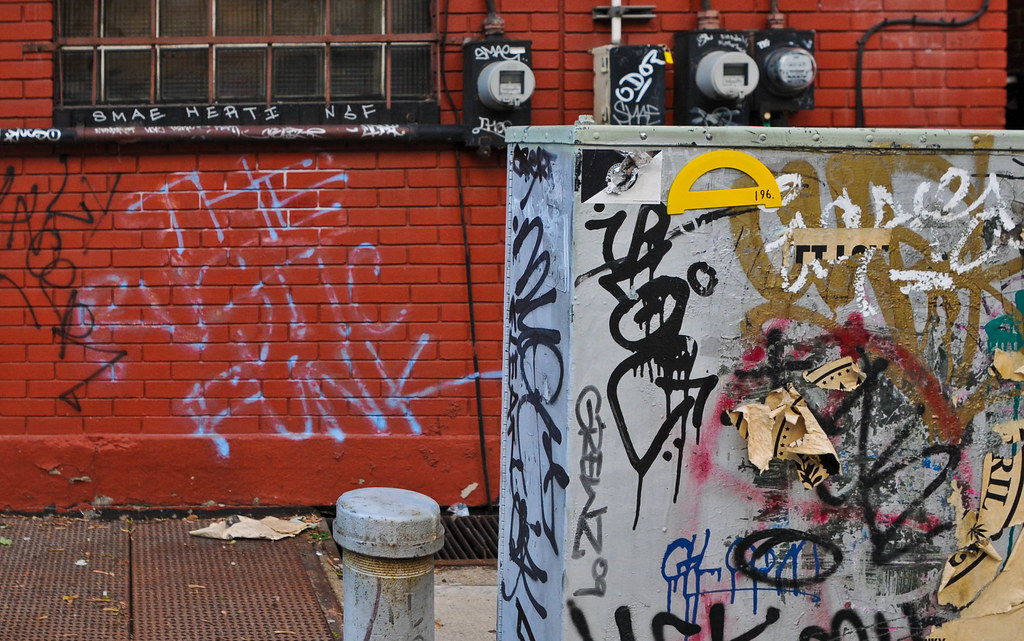
The Puzzle of the Pittsburgh Protractors

Observant Pittsburghers have noticed a puzzling phenomenon: several numbered protractors have been appearing on city streets. They look like this:

A blogger named Eric has compiled over 60 protractor "findings".

People in cars (some might call them cagers) don't notice much, what with their cellphones, radios, air conditioning, and 3000 pounds of metal surrounding them, but bicyclists notice a lot of things when they're moving on the street. This is a Bike-PGH discussion of the protractor puzzle; the comments are quite funny.

Today my friend K. found Protractor #230 on the switchback ramps connecting the Washington's Landing bridge to the North Side trail.


June 19, 2011

Pittsburgh Bike Belt : A Modest Proposal

This has been a big year for bike trails in Pittsburgh, and there is the promise of more to come. Already we've seen the Point-to-24th Street / Strip District Trail opening and the long-awaited Duquesne-to-Munhall Steel-Valley-Coaster-Pipeline Trail opened on Friday. Both of these are tremendous.

This year we also expect to see the SouthSideWorks Trail complete, the PIT Airport connector trail will open, and we may see the Sandcastle connection open.

Which brings us to the matter of Names and Naming Trails. It's great to recognize people and to preserve memories by giving trails effective names like the "Mon-Whorf Trail". Some names are unwieldy, such as the Ruprecht S. and Penelope K. Rutherford Lower Burrel Multi-Use Health and Wellness Trail. If the official world gives an unwieldy name, the real world will assign a more pragmatic one, hence: Jail Trail, Casino Trail, Strip Trail, Southside Trail.

Although each community is justifiably proud of their efforts to bring forth their trails, for outsiders the distinction between the Southside Trail and the Baldwin-Brentwood-Whitehall Trail isn't intuitive. In the same way that "ontogeny recapitulates phylogeny", the nomenclature of our trails restates the condition of our fractured local government.

With all due respect to the Bard, naming is not a trivial issue; on Friday, I had the occasion to call 911 seeking help for an injured rider, and it took a little while to suss out the specific name of the trail I was on. We may need a better system of trail names.

Fortunately, Pittsburgh has previously dealt with the problem of naming and marking routes that run through a variety of municipalities and domains. Let's look at some maps.

The map of today's Pittsburgh bike trail system looks like this:

(click image to embiggen in a new window)


Imagine What The Future Might Hold


Imagine what it would look like if the region is able to:
  • fill in the southern gaps of the Montour Trail
  • extend the Panhandle Trail on existing abandoned rail lines into West End Circle
  • extend the Casino Trail to Neville Island
It might look like a belt system of trails:

(click image to embiggen in a new window)


Through a dozen local successes, we're on the verge of adding a new "belt" to Pittsburgh's infamous Color Belts: the Bike Belt.


I propose that we rename (and re-sign) the various Pittsburgh regional trails (in at least Allegheny and Washington counties) as the Bike Belt. Using the existing, much-loved and parochially functional color-belt framework would connect "new-green-bike" Pittsburgh with "yinzer-mullet-n'at" Pittsburgh.