Economists generally warn us about bubbles, where the pressure of growth exceeds underlying fundamentals; once speculation sets it the bubble becomes an attractive nuisance, and when the bubble pops it leaves a lot of people suffering, except for the smart ones who know enough to get out early.

Facebook has become an information bubble. It knows so much about so many people, but the real treasure is that it knows who your network is. This accumulation of glommed data is a marketer's fantasy come true. And yet, Facebook has not found a way to make money.
This week's New York Times artice,
The Three Facebook Settings Every User Should Check Now, is notable for a few reasons. To myself it's notable in that it's lifted, word for word, from its original position on
Read Write Web. Usually the Grey Lady does not simply repurpose content from another source without explicitly acknowledging the provenance, but perhaps times are changing.
The most important thing about the article is its urgency and its degree of specificity; click this, hover there, choose this. This sort of specific guidance from a source with geek credibility is commendable.

IANAF (I am not a Facebook-er), but I've had friends show me what they do on Facebook. I haven't tried it because I'm concerned it's a lot like doing heroin, one flirtation and you're hooked. That seems to be the case among people I know.
Last week a friend of mine sent me a link to his Facebook page so I could see his avatar image. I also saw the avatars of a dozen of his friends. Being somewhat geeky, I pressed Shift/F5, the page refreshed, and I saw another dozen friends. I did that a few times and realized that anybody can sequence through all of any Facebooker's friends.
I followed a few of the links, because I know some of his friends. On their Facebook pages, I found other people I knew among their friends - these would be "co-friends". I found I could even drill down to friends-cubed, third-level friends. This is sort of the opposite of Six Degrees of Kevin Bacon.

The thing that concerns me is that people are loading their information about themselves and their friends into Facebook, assuming that FB is (1) benign, (2) cost-free, and (3) sustainable. The problem is that eventually, Facebook is going to have to make money.
When a guy with a forest needs money, he sells firewood.
When an Afghan farmer needs money, he sells opium.
When a company with your information needs money, they sell your information.


In his new book, Jarod Lanier writes regarding Facebook, "
The real customer is the advertiser of the future, but this creature has yet to appear at the time this is being written. The whole artifice, the whole idea of fake friendship, is just bait laid by the lords of the clouds to lure hypothetical advertisers—we might call them messianic advertisers—who might someday show up".
"
The only hope for social networking sites from a business point of view," Lanier writes, "
is for a magic formula to appear in which some method of violating privacy and dignity becomes acceptable."
Facebook users are giving this Corporation most of their key information. Facebookers that take surveys and complete profiles give even more information that helps FB assign them to various demographic profiles.
When Facebook goes bankrupt, a few interesting things will happen. Their assets will be reorganized and used in the most financially beneficial way. What's interesting is that the Facebook privacy policy and privacy guarantee evaporate into vapor at the moment of bankruptcy. When the Facebook bubble bursts, the privacy policy pops too.
There will be a bidding war for FaceBook's database, which will become more valuable in bankrupcty (free of the privacy policy) than it ever was during Facebook's tenure.
The smartest thing for the buyer of the database to do would be to immediately reintroduce the Facebook service, encouraging Facebookers to continue contributing and updating their information, only now without the same privacy policy.
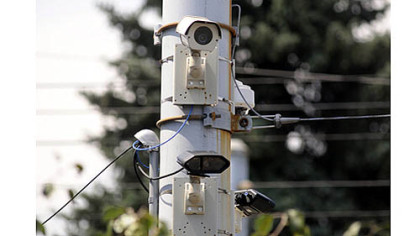 In an earlier post (Protecting the Port of Regent Square, 7/29/2012) we discussed how DHS was installing license plate scanners in Swissvale and Edgewood, funded by the federal Port Security Grant Program. (Post-Gazette)
 Update: ArsTechnica reports that the Feds are soliciting a contractor to build a datacenter to connect all the little license-plate scanner nodes into a national scanner grid.


 Another problem is privacy; I may not want Big Brother to have records of where my car has been. Advocates of a GPS-based road tax are quick to promise that the GPS data will only be used for revenue, and possibly for some criminal investigations.
 Paul Taylor, the Sprint/Nextel Electronic Surveillance Manager, said: We turned on the web interface for law enforcement about one year ago last month, and we just passed 8 million requests. So there is no way on earth my team could have handled 8 million requests from law enforcement, just for GPS alone. So the tool has just really caught on fire with law enforcement. They also love that it is extremely inexpensive to operate and easy (to use).
 That's just one telecom company, giving up location info 8 million times over 13 months, without any interaction with the courts. No checks and balances - the police go to the web portal, submit their request, and they get the info.


 Posts

