Showing posts with label ToC. Show all posts
June 08, 2011

Chaos and NextGen: Panama Canal, Train Tunnels, Concrete vs Satellites


There's a gross over-simplification of chaos theory that goes: a butterfly flaps its wings in Africa, the monsoons run late in India, and we get tornadoes in Joplin.

We assume that the butterflies are benign, just like the birds are.


The National Gateway railroad project shows similar inter-dependencies and conditional sensitivity, and to me it carries interesting points about the NextGen aviation proposal and project management.

The Panama Canal is a money-maker. As shipping between Asia/China and the United States has increased, the number of ships trying to move materiel to the US East Coast has exceeded the capacity of the Panama Canal (which is fixed in terms of ship size, ships per hour, etc). Demand exceeds supply, costs go up, schedules slip, China looks for another path and starts sending more and more ships to the West Coast.

As the shipping business and the money moved away from the Panama Canal and toward West Coast docks and transcontinental train lines, the Canal people said 'Wait we want that money! We're going to widen the Canal, so really big ships can come through.'

When the train people found out that the Canal people were going lateral, they looked at their capability to handle the new volume and realized that the train structure can't handle it. The railroad solution was to go vertical and run double-height trains on the legacy tracks, doubling the railroad capacity.


But wait; the railroads have a problem. It's easy to run double-height trains in the open air, but it's impossible to run double-height trains through some of the oldest legacy tunnels, which were built in difficult situations to single-height train specs.

The railroads have embarked on a program to make their tunnels taller. Sometimes they raise the roof, sometimes they lower the floor. It's a huge effort called the National Gateway.


This summer in Pittsburgh's Southside Works, the "tunnel park" shown in the photo above (where the CSX train tunnel runs under the grass) will be excavated, raised, and rebuilt, as explained by the Post-Gazette's most excellent Larry Walsh:
The Panama Canal is nearly 2,200 miles from Pittsburgh, but ripples from a $5.25 billion canal expansion will be felt here... when construction crews are expected to excavate the grassy strip in SouthSide Works known as Tunnel Park. There's a railroad tunnel down there, and CSX Transportation wants to raise the roof on it.

They hope to finish the work by 2015, when bigger ships that will be able to use the expanded Panama Canal will start plying East Coast ports, including Philadelphia, generating more demand for trains to move goods in the East and Midwest.


I found another unexpected impact of the Panama Canal project last week when I was riding the bicycle trail from Confluence to Rockwood, near a place called Pinkerton PA. Let's look at the Pinkerton Horn, and the train tracks and tunnels that run through the mountain there.


This map shows the curve of the Cassellman River, which gives the Pinkerton Horn its shape, and the path of the original train line and tunnel:


This map shows the location of the current CSX train tracks and tunnel, which allowed the railroad to abandon the old tracks and problematic tunnel.


This map shows how the original train bed was used for the GAP bike trail, and how the trail circumnavigates the Pinkerton Horn because of the tremendous expense of rehabilitating the closed, legacy tunnel:


Daylighting the Pinkerton Tunnel

The double-height trains won't be able to fit in the Pinkerton Tunnel. Because of the geology, the railroad has decided to "daylight" the train tracks that run through the mountain, which means they'll remove all the earth above the tracks until daylight shines down upon them. (click for project details) It's a huge amount of material. In order to accomplish this, the railroad has chosen to cut down all the trees above the bike trail.

This map shows where the mountain will be cut away over the new train line, "daylighting" the tracks and permitting double-height train cars. It also shows the central area in which the trees are being cut down along the top of the ridge.


This photo from last week shows the bike trail at the west portal of the old closed tunnel, and the deforestation above the trail detour.


A Project Management Perspective

From a project management perspective, I think about all the times I've tried to get something done and run into "You can't do that, because yada yada yada". These transportation engineers run into constraints and say, hey let's just remove that mountain. Wow, just wow. I'd like to have some of that mojo.

A NextGen Perspective

NextGen is industry's proposed satellite-based aviation system.
The Panama Canal:
  • From a Theory of Constraints perspective, the Panama Canal is the constraining factor in shipping between Asia and the East Coast.
  • In a curious NextGen analogy, once again we see that capacity is about the constraint, and the constraint is concrete.
  • You could give all those ships brand new GPS units, but it wouldn't increase capacity at all.


The Railroads:
  • The capacity constraint was the tunnels (concrete)
  • giving those trains updated satellite links won't do a thing to increase capacity


It's all about the concrete.


July 05, 2009

Runways and the Theory of Constraints (TOC)


The Theory of Constraints (TOC) is a systems philosophy from Eliyahu Moshe Goldratt, an Israeli physicist who became an American management guru. One of the things I enjoy about Dr. Goldratt is that he comes from a Rabbinical family, so he often communicates the findings of a physicist and a systems analyst in the manner of a Rabbi's teaching, usually through illustrative stories.

Here's a story about how TOC (at a very rudimentary level) is used in a manufacturing situation at Acme Widgets.
  • The Loading Docks can unload 25 tons of raw materials a day.
  • Assembly can take in 20 tons of raw materials and produce 1000 widgets per day
  • The Paint shop can paint 500 widgets a day.
  • The Pack&Ship department can ship 800 widgets a day.

The Loading Docks are a scene of great complexity and most of the factory's problems. Materials arrive in railroad cars and trucks. Forklifts move pallets off the trains and trucks. Most conflict and injury happens on the Loading Docks. There are accidents between the forklifts driving around with their pallets and the pickup trucks carrying assembled widgets to the Paint Shop.

Based on current demand, the factory is producing and shipping about 400 widgets/day. A new Army contract means they need to increase output to 1000 widgets a day. While this is a great opportunity, Management knows they need to make investments and make changes to produce so many more widgets a day. The Board has arranged financing of $5 million/year for the scaleup.

At a manager's meeting, the CEO asks the managers, how do we spend the $5 million to scale up up to 1000 widgets/day? The production manager, the facilities manager, and the HR and Legal departments all agree: solve the problem on the Loading Docks. A redesigned layout will reduce congestion and confusion, reduce accidents, and make everything run more smoothly.


The CEO is pleased; he didn't think the managers would agree on a solution so easily. He asks, Anybody got anything else to say? Smithers, an old timer who'd been there longer than anybody else, spoke up and said, "You can spend the $5 million on the loading docks, and you'll get a beautiful, efficient facility. State of the art; something to be proud of. However, you will at most increase production by only 25%, and you will only satisfy half of the total demand."

There was an awkward moment of silence; usually, Smithers did not speak up at meetings. After the silent moment, they found their voices and started challenging Smithers. How could he know this? What was his basis? Didn't he see the confusion and congestion on the loading dock every day? The group had almost convinced itself that old Smithers was just too resistant to change, and he wasn't embracing the new paradigm. Then the CEO asked, "Smithers, tell me why you think that way".

Smithers said, "I know the Loading Dock is very visible to you all, and you see all the gritty happenings from your windows. But that's the nature of a loading dock. I also know that our paint shop is the limiting factor in our production capability. The paint shop can only paint 500 widgets a day; that's the choke point. We can only Pack & Ship 800 widgets a day, but that's a secondary constraint. The paint shop is your real problem."

Now the room was silent; he had their attention. "If you study it, you'll see that the Loading Dock is completely capable of handling the increased volume. Assembly will be right at capacity at 1000 widgets/day.


Smithers continued, "You need to double the capacity of the Paint Shop, and increase the capacity of Pack&Ship by 20%. If you run two shifts in the paint shop, you can paint 1000 widgets a day. You'll probably need to boost the Pack&Ship department with overtime to go from 800/day to 1000/day.

"Total cost over a year will be about $1 million. If you decide to spend a half-million organizing the Loading Docks, that's not a bad idea, it'll reduce accidents and injuries. But the necessity is: you've got to focus on the constraints."


The board quickly agreed. After the meeting, the CEO signaled Smithers to wait a moment. The CEO asked, "Smithers, how did we come so close to making a catastropic mistake?"

Smithers answered, "Well, boss, they're all good people. The Loading Dock is outdoors and in the weather, and Facilities has most of their problems out there. Production sees the complexity and disarray, and he'd really like to get it all organized but he doesn't know how. HR and Legal hate dealing with the Union out there, and they're legitimately concerned that the Loading Dock is the only place where injuries happen. A sparkling new loading dock just appealed to their needs, and you know that Acme LoadDockCo's has been trying to sell an overhaul to them for a while. I think they were a big sponsor at last year's golf tournament. Problem is, it just doesn't address the operational constraint."
My amateurish example, of course, only scratches the surface of the Theory of Constraints, which has a robust set of tools and philosophies to make the concept usable. TOC is most often used in manufacturing, but the techniques of TOC apply to many fields.

The primary constraint in aviation delays and congestion is the runway. You can deliver 300 airplanes an hour to the terminal airspace using satellites and altitudes and all the technology, but if the runway acceptance rate is 60 airplanes/hour, you're only going to land 60 an hour. Runways are the constraint.


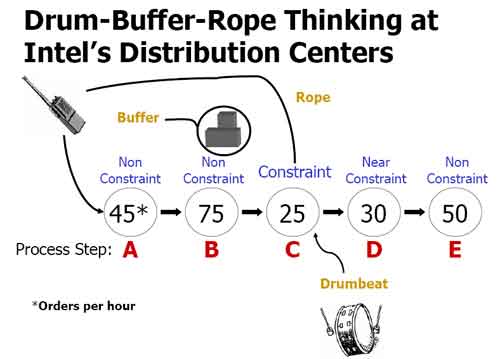
Drum - Buffer - Rope

TOC can teach us more about managing the constraint. The primary TOC mindset for managing a constrained system is called "Drum - Buffer - Rope" (DBR), and it would be informative to see how that might apply to the problem of aviation delays. Remember that in our scenario, the takeoff and landing runways are the constraint.

The drum is the physical constraint of the system: the component or operation that limits the ability of the entire system to produce more. The entire system must march to the beat of the drum. We optimize the situation by making sure the drum has work to do, and that anything the drum has processed does not get wasted. In our application, making sure the drum has work to do means never leaving a gap on the runway unused, and avoiding waste (for instance) means avoiding go-arounds which waste an opportunity.

The buffer protects the drum from inactivity, so that it always has work flowing to it. Buffers in DBR have time as their unit of measure, rather than quantity of material. This makes the priority system operate strictly based on the time an order is expected to be at the drum. In aviation, the buffer is a queue of aircraft waiting to takeoff and land; having a small buffer available ensures that the drum (runway) will be used as efficiently as possible.

The rope is the work release mechanism for the plant. Only a "buffer time" before an order is due does it get released into the plant. Pulling work into the system earlier than a buffer time guarantees high work-in-process (WIP), gridlocks the entire system, and increases errors.

There are implications of Drum-Buffer-Rope throughout our aviation system.


Critical Path Method vs Theory of Constraints

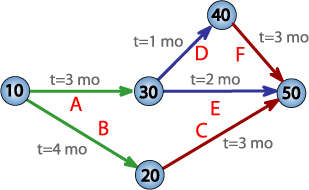
Another technique that closely parallels the TOC philosophy and the Drum-Buffer-Rope technique is Critical Path Method (CPM) of project management.

In this example of a multi-dimensional work process with both interdependent and non-dependant activities, the minimum time for project completion is seven months. There are two critical paths, in which any delay will result in a delay of the project.
    Critical Paths:
  • Activity B and dependant Activity C (seven months)
  • Activity A, dependant Activity D, and dependant Activity F (seven months)

Because they are on the critical path, any delay in B,C,A,D or F will result in a delay in project completion.

Note that Activity E, which takes two months, is not on any critical path. Activity E has a float of two months, which means that E could take as long as four months without delaying the project. This understanding gives project managers some priorities in responding to challenges; a two-week delay on Activity E is not any cause for concern.

In our application, the takeoff and departure runways are the critical path; any delay at either results in a delay of the flight.

Some critics of TOC contend that TOC merely repackages multipath CPM concepts into linear manufacturing applications. For me, I think TOC presents time and capacity issues with more nuance and flexibility than I see in CPM.


February 16, 2009

Tour of California: Theft, A Debut, New Tech, Suffering

Someone stole Lance's time trial bike.

Lance Armstrong's time trial bike, which he rode to 10th place in the prologue, was stolen off a team truck along with three other bikes. The other bikes stolen belong to Janez Brajkovic, Steve Morabito and Yaroslav Popovych.

In a wonderful example of Social Media, Lance immediately Twitter'd an all-points-bulletin and offered a reward.

This bike doesn't even have a kickstand. If I ended up with it, I'd have to put racks and fenders on it.


Media presents the innocent savant, raised in the wild. Canada.

Svein Tuft makes his big-league cycling debut, promoted by the media as a Canadian youth who grew up in the mountains, spending seasons riding his bike with his dog. Tuft disdained cycling's drug culture so much that he left cycling; he was persuaded to come back because he was promised that (1) his team would be drug-free and (2) he was welcome to disappear back into the mountains in the off-season.

This is the best "noble savage" story in bicycling since the media introduced that Amish guy, what was his name, Floyd Landis. But Tuft is the story you want to believe even though you know you shouldn't - when they hired him to report to a Los Angeles training camp in 2003, he rode his bike there (from Canada). This fellow will be an interesting story, and time will tell if he's another Lance, another Floyd, or another Sidd Finch.

New technology introduced - electric gear shifting

Shimano’s electric shifting system, known as the Dura-Ace Di2 7970, is being used by three professional teams competing in California: Columbia High Road, Garmin Slipstream and Rabobank. This is a trial to see how the new gear holds up before the three Grand Tours (Tour de France, the Giro, and the Vuelta). For time trialists, the new system allows riders to maintain their aero tuck even when shifting.

Stage One : Riders in the Storm

This is what Francisco Mancebo looked like as he won Stage One. Let me say that when a guy who gets paid to show his sponsor's logo crosses the finish line looking like that, he hasn't had any fun, and neither has anybody trying to stay with him. Imagine doing that for 107.6 miles. That's a lot of suffering and work.

Stage Two : Monday

Thomas Peterson (Garmin-Slipstream) won today's stage - I love the argyle team kit! Last year's winner and California favorite Levi Leipheimer (Astana) grabs the yellow jersey as the overall leader. Fabian Cancellara, who won Saturday's prologue, withdrew from the race at the first feed zone.
February 07, 2009

Tour of California Lance, Floyd, Levi, and George


In one week (February 14th), the Tour of California kicks off. It's a bicycle race on public roads, contested by teams of bicyclists.

Bicycle racing by itself is a funny kind of sport in the way that Wrestling or Arena Football are funny - there's athletes, scandal, hokey drama, but usually there's enough apparently virtuous contenders to make you want to believe it's plausible.

When bicycle racing happens with teams of riders, crammed into a pack (the peloton) of elbows and knees, the sport gains all the strategy and purity of Roller Derby. The costumes are pretty similar, too.

There are big names among the riders, and big-money companies sponsoring teams in hopes of burning their logos into the national consciousness. The main sponsor of the event is Amgen, a biopharmaceutical company. One of Amgen's products is EPO, which is the blood-doping agent most often seen in cycling scandals, and Amgen is sponsoring the ride, proving that somebody at Corporate has a sense of humor.

Each day, these jerseys will be awarded:
Points LeaderMost
Courageous
King of the
Mountains
Best SprinterBest Young Rider


One key bit of drama will be Team Astana. Johan Bruyneel is the Director, and the riders include Lance Armstrong, Alberto Contador, Andreas Klöden and Levi Leipheimer. Levi Leipheimer is a favorite of mine, he seems a quiet guy that works at it, the ToC is in his backyard, and he's never failed a drug test. Lance's return will provide a spectacle, especially with his former Postal teammates now on opposing teams.

Team Columbia Highroad features George Hincapie, Lance's former domestique (subordinate). Always the bridesmaid rarely the bride, George is getting long in the tooth.


Team Ouch (formerly HealthNet) features Floyd Landis' return to pro cycling. He won the inaugural 2006 ToC, and has had a new hip installed since his 2006 Tour de France win and debacle. Team Ouch is sponsored by Floyd's physician, and seems more like a vehicle for Floyd's reintroduction than a serious team.


Let us not forget that Lance made his name by winning the Thrift Drug Classic in Pittsburgh in 1992, '93, and '94. In the 1995 photo below, Andrea Peron (L) leads Lance Armstrong (R) across the crest of Mt. Washington. Ah, the things that used to be here.
(photo credit: Doug Pen)


The ToC will be on television via Versus.


By the way, I'd like to rollout my favorite jersey, which I received as a Christmas gift and hope to get a lot of use out of in the spring: The Old Guys Who Get Fat In Winter team jersey.