November 28, 2011

Separation Anxiety: A New Birther Meme

I am intrigued and often amused at the dynamics of misinformation and disinformation, because they lay bare the elements of effective, credible narratives and identify our blind spots. They often seem to generate a higher speed of distribution if they can tap into a latent need in the audience.

For instance, look at the effectiveness of the corporate archive footage of Rockwell's Retroincabulator (and the subsequent update, the Turbo Encabulator). There are lessons to be learned there.

One recent local example would be the spoof FOP Press Release that did, in fact, become a news story that refreshed public awareness of the issue and took on a life of its own when the authorities over-reacted.

Originally from Alex Leary of the St. Petersburg Times, via Politico, we have this video developed on behalf of US Senate wannabee Steve Welch:


I have to wonder if introducing yourself to the electorate by demonstrating your capacity for smooth, glossy disinformation is going to have unintended consequences. (If, in fact, elections still have consequences — but that is a topic for another day.)


A Countdown of Sorts: 3 Days and a Wake Up
November 25, 2011

The Logic of Black Friday and Occupy Wall Street

I'd like to be sure that I've got this right.

People who camp out in cities to call attention to their cause and exercise their constitutional rights of free speech and assembly are dangerous anarchists who deserve condemnation and brutality, including chemical warfare.


People who camp out at stores to buy things and who generate free "news" coverage with the "get shopping" message are smart shoppers and valuable contributors to our consumption-based economy. In a way, they're economic patriots, braving the harsh elements for the sake of their families and our common good.


Okay, I just wanted to make sure I understood.


A Countdown of Sorts: 4 Days and a Wake Up
  
November 24, 2011

"A Christmas Story" - Ralph and the Leglamp On the Big Screen

What to do with the days after Thanksgiving?
Watch a classic Christmas movie on a modern big screen - from the balcony!


 The Strand Theater, Zelionople PA
724.742.0400
Friday 7.30
Saturday 7.30
Sunday at 2pm
   $5 General Admission, $4 for Seniors 60+
Box Office Opens 1 Hour before Showtime
House Opens 1/2 Hour before Showtime


November 23, 2011

What do we expect when we give police military equipment, training, and orders?

We must point out that for all the discussion of the militarization of civilian police forces and the depiction of civilians as the enemy, we do not intend to criticize the policemen themselves.

We do intend to criticize their training, equipment, expanded mission, and the lack of accountability among the leaders authorities who give them their orders. We are putting these good people (police) into terrible situations with unrealistic expectations, the political leadership expects special-forces capabilities in civilian settings, and the military-industrial complex sees the Mayberry Police Dept. as a profit center.


This criticism is not about the good men and women who put on the uniform. When authorities put a squad of highly trained men with assault weapons into a crowd of 2000 fully enabled college students with impractical orders, what do we expect to happen other than another Kent State? It's the authorities who are bungling this. At one time, they were called The Establishment.


Post-9/11 Trends in Children's Dolls


Toy manufacturers are eerily good at presenting military hardware and military dolls action figures. Admiral Rickover condemned Ravell for producing a model of the Polaris submarine that he claimed provided the Soviet Union with classified information.

The toymaking industry's affinity with soldiers and weapons may be that they share a seminal root; maybe the guns and gear are just very expensive and very dangerous toys for older little boys.

The various incarnations of Hasbro's GI Joe presents a chronicle of the changing role, definition, and kit of the modern military. They've followed our post-911 lead and expanded the production line to include policemen. It's kind of interesting to see the progression.

The earliest common point of military figures and police figures is, inevitably, the military police (MP) figure.

legacy Military Police United Nations peacekeeper MP


These are the legacy civilian Police GI Joe's:
classic NYPD patrolman
 NYPD SWAT Sniper
 NYPD Riot Squad


This is the 2011 Police Officer GI Joe, equipped with helmet, ballistic safety glasses, 9mm Semi-automatic pistol with utility belt, MP-5 tactical assault rifle with 2 clips, gas grenade and police dog with spring-loaded jaws (to maintain the essential "Selma" capability):


From Hasbro:
This 12-inch G.I. JOE figure is a real American hero with the real firepower he needs to prevail against the enemies of the country he serves! In his authentic police uniform and safety glasses, he’ll look like the warrior he is whether he’s fighting the battles you send him into or standing in your collection. Put his pistol or gas grenade in one hand, leaving the other hand free for his K-9 companion’s leash! Order will be restored with your G.I. JOE figure on patrol!


Maybe it's just me. That's not a police officer, that's a soldier wearing fatigues with a gas grenade and an assault rifle. This is not the guy who should be giving a ticket to college kids for camping without a permit.

Finally, toy collectors are expecting the doll action figure depicted below to be introduced as the first "Homeland Security GI Joe", also known as "Need-to-Know Joe".


His uniform doesn't need any insignia or identification of agency. You don't need to know.

The local police vs federal agents distinction is irrelevant.

The civilian vs military distinction is irrelevant. You don't need to know.

The government vs contractor distinction is irrelevant.

When Need-to-Know Joe tells you to do something, you just Obey.

Questioning is Resistance.
Hesitation is Resistance.
Resistance is futile.
-

Free Market Solutions to Social Justice Problems

This has got to make the Ron Paul - Michelle Bachmann contingent happy: the free market is responding to the Invisible Hand by providing solutions to problems of social justice. We don't need no stinking government. Industry has got our back!

From Amazon.com: Defense Technology 56895 MK-9 Stream, 1.3% Red Band/1.3% Blue Band Pepper Spray (click on the image at right for product details)

You can count on the Mark-9 to get the job done!

Amazon is, in a way, a lot like a web forum because the best content is generally found in the product review comments.


If you made this up, nobody would believe it.
November 22, 2011

Do You Need A Weatherman?

A smarter writer than I recently wrote, This is Not Going to Work, and I'd like to stand on those broad shoulders for a moment.

Let's remember the last time we had open conflict in the streets, the last time that American police were asked to face angry crowds of their fellow citizens, the last time that American cities burned. Let's remember the 1960's, somehow 50 years ago.

There were two causes challenging established authority in the 1960's: the civil rights movement and the antiVietNam war movement. The police response, which was no more and no less than the official, intended, desired response of the Establishment, escalated and went over the top. Although people held different opinions, among some of the American people the government, the Establishment, and the military-industrial complex lost the consent of the people.

Harlem, NYC, 1964
Chicago, 1968


When the System lost the consent of some portion of the people, most of the disillusioned remained in their box - but not all of them. Some went to Canada to avoid conscription in a war they didn't support. Some chose to respond to the challenge, and they worked in groups designed around the two conflicts: Anti-War and Civil Rights.

Remember the SDS, the Students for a Democratic Society, with a manifesto written by Jane Fonda's husband? Remember the Weather Underground, which declared war on the United States? Bill Ayers? Bernadine Dohrn?

Remember the Black Panther Party? Bobby Seale, the cookbook author? After the Panthers were shut down, the survivors formed the Black Liberation Army?

Quick Question One: In what American city was a building blown up in a 1970 bomb-making operation? Greenwich Village, New York City.

Quick Question Two: In what American city did a police aircraft drop a bomb onto a block of buildings containing a black liberation group? Philadelphia, the city of brotherly love.

Right now, the Occupy movement is a mostly white-male display of GoreTex and modern camping equipment that would make any sporting-goods store salivate at the notion of sponsoring them.

If we keep responding to public assembly and freedom of speech (see: The American Revolution) with military supression tactics, most of the protesters will pack up their tents and their GoreTex and go home, probably after the next election. But some of them will become Weathermen 2.0.

Kristin Stoneking is a campus minister at UC Davis, and she has been recognized for her leadership in the aftermath of the UC-Davis pepper spraying. She writes,
... in a larger sense, we are all in danger of being trapped. We are trapped when we assent to a culture that for decades, and particularly since 9/11, has allowed law enforcement to have more and more power which has moved us into an era of hypercriminalization. We are trapped when we envision no path to reconciliation. And we are trapped when we forget our own power.

It's bad enough that we're radicalizing Pakistanis. We shouldn't be radicalizing our own people. "You don't need a weatherman to know which way the wind blows"

November 21, 2011

Are we all Black and Palestinian Now?


Maybe this happens to hipsters as they grow up age - you think you've encountered something new and obscure, you're really on to a new niche here, and then you learn that all those old people down at the senior center have known about this since like forever. Sort of like my Dad drinking PBR.

Say you're a privileged mainstreamer - you're the norm, plus/minus one standard deviation. Bad things are happening to another, smaller group in society. Do you respond? Do you resist? Or, if it doesn't affect you directly and you're busy, do you move along?


These bad patterns persist for decades. The malefactors become more rigid in their behavior, and as they train the successive generations those habits become dogma. Sheriff Jim Clark trains Deputy Inspector Tony Bologna in the way things really work, and they themselves are dehumanized by the experience.


Is it possible that after 50 years, the abuse of the minority becomes so accepted that, under stress, the power structure extends it to the majority? Does the military training, equipment, and mindset given to once-civilian police departments after 9/11 accelerate the trend?

... this sort of abusive behavior is reported routinely by people of color and by people of lower economic status. Yet their complaints are routinely dismissed or ignored in the media. Sometimes it takes middle and upper class white people getting hurt to get the media moving (Fallows)


Congratulations. Post 9/11, now we're all Black. And Palestinian.

Not to say that we're familiar with their issues, understand their culture, and can converse with them - nowhere near that.

But that cop/soldier, who's been treating Black people and Palestinian people that way for a long time, has reached a place where he's going to start treating you that way. Not all cops/soldiers, just the fringe. The Tony Bolognas and the John Pikes see you that way.

You think you've discovered a new problem, but "some people" have been dealing with it for a long time. Kind of educational, isn't it?

Gosh. If "we" had known back in the day, maybe we could have avoided this.


A Countdown of Sorts: 7 Days and a WakeUp
November 18, 2011

Protect-and-Serve or Seek-and-Destroy: Are Police Still Civilian After 9-11?

Increasingly domestic law enforcement in the United States has a paramilitary perspective.

The desire to equip and train first responders, which serves both a legitimate purpose and meets the agendas of industry and politicians, has introduced military technology into civilian/domestic police forces to an unprecedented degree. For the Homeland Security-Congressional-Military-Industrial-Complex, it's a market opportunity wrapped in the flag.

When a G-20 type event comes to a city, or when law-abiding citizens exercise their constitutional rights of protest and assembly (which, BTW, was kind of what the Revolutionary war was about) it is handled as a military event. The photo shows military officers on the streets of my city during a G-20, when tear gas, stun grenades, and the LRAD sound cannon were used on peaceful citizens.

Edit 11/18: The LRAD made it's debut in New York City Nov. 17th. "The peculiar weapon system symbolizes the creeping Israelification of America's local police forces and the Palestinianization of all who challenge the predations of a zero tolerant 1 percent master class.       h/t:spork


The seminal difference is, as Arthur Rizer & Joseph Hartman pointed out in The Atlantic this week, that the role of police is to "protect and serve". Who do they protect and serve? Citizens. The role of soldiers is to seek and destroy. Who do they destroy? The enemy, and an external enemy at that.

When military tools, and military training, and military techniques are extended into domestic operations, the nature of civilian policing changes. Most alarmingly, the description of the population changes; what were once "civilian protesters" too easily become "the enemy".

We have a distinctly different set of laws/rules/norms addressing domestic behavior and foreign warfare. Is waterboarding permissible for busting drug smuggling? Can we use drones to monitor political protests? (See, Texas city deploys drones.)

But wait there's more - if we conducted a one-year war after 9/11, perhaps the opportunity for military contamination of domestic police forces would have been limited. We're a decade into these wars. There are a decade's worth of veterans coming out of the service, and God bless them for it, and they're looking for work.

Who's employing those vets? Police departments, State police, and the FBI. It's not just that we're giving military tools to civilian Barney Fife's, who understand that Thelma and Aunt Bee are citizens; we're taking these people out of Iraq and Afghanistan and Somalia etc and putting them in uniform in Podunk and giving them the same tools they've used before - does anybody expect that to not have an adverse impact on civil liberties?

Perhaps the two ends of the spectrum of militarized police forces are New York City and Portland, Oregon.

In New York City, home to Ground Zero and the NYPD, a police department with the capability of taking down planes without federal guidance when it sees fit, police are perhaps more militarized then anywhere else in the country (excluding DC).

NYPD is responding to the Occupy protestors as the enemy. They're encouraging the city's vagrants to “take it to Zuccotti”. They used a night-time "shock and awe" display to force the demonstrators out of the park.

It leaves me wondering: who/what are they serving and protecting?


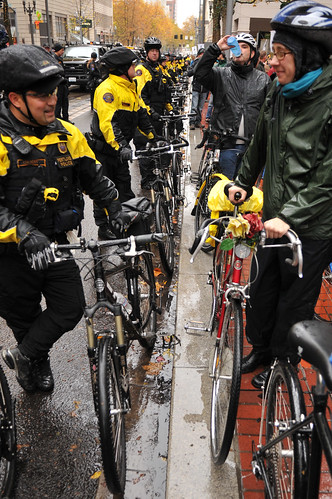
In Portland, Oregon, the police have taken another approach. Here's the Portland headline: Police on bikes meet protestors on bikes: Smiles, dialogue ensue.

Portland police have taken the initiative of providing security for the Occupy citizens. "If we weren't providing a large police presence this wouldn't be safe," Police Chief Mike Reese said, as he did a walk through the camp today. "The dynamic of the camp is changing. We're finding more homeless, and road-warrior type street youth here."

Mayor Sam Adams is tracking overtime expenses. "In seeing what we are facing here in terms of overtime costs versus what some other cities have faced in terms of overtime costs related to less than peaceful interactions, I'm pleased that our costs will be lower because we have dealt with this in a more peaceful manner than other places," Adams said.


Is it protect-and-serve or seek-and-destroy?
Are the Occupy protesters Citizens or Enemy?

If we zapped a 1770 American colonist protesting the King into today's Manhattan, would we tolerate his protest or lock him up?


A Countdown of Sorts: Eight Days and A WakeUp


November 14, 2011

The Cult of Personal Loyalty: A Moral Ponzi Scheme


Once Upon A Time, there was The Mission: Preach the Gospel (the church). Educate Pennsylvanians (Penn State). Run an investment house (Bernie Madoff). Win the Tour de France (Lance Armstrong).

Sometimes the Organization loses sight of the Mission. Politics and money provide incentives to drift. Short-term goals provide seductive motivation. While the mission statement plaque is still hanging in the lobby, now the organization is really about maintaining power; it has been corrupted.

One way of maintaining power in a human system is developing a cult of personal loyalty, in which the individual's loyalty to the (CEO, Coach, Manager, Bishop) is prized more than accomplishing the Mission.
Feb. 2 1943, The Christian Science Monitor   link


"Many of President (Franklin D.) Roosevelt's best friends and well-wishers have often asked why he is so seemingly obtuse to unethical or improper appointments, business or lobbying activities, etc.. when they come from his own immediate circle, and so vigilant on numerous other far less important matters? What is this Achilles heel, anyway?

"The answer, it always seemed to me, lies in Mr. Roosevelt's continual and deep demand for personal loyalty. I would almost call his political faith the 'cult of personal loyalty.' From his friends, associates and staff he expects and returns a feudal bond. Manifestations of personal loyalty have marked his whole political career . . . Labour Secretary Perkins, Harold L. Ickes, Harry L. Hopkins. Thomas G. Corcoran, and many another.. . as long as these people continued to give fervent loyalty, as long as they kept their faith of their feudal bond, they could, in effect, do no wrong. Loyalty was enough for the President.       Edwin D. Canhom


A cult of personal loyalty requires perceived power, the promise of future benefits, and a claim to special insight. As the cult grows beyond a few participants, it can permit indulgences to the select few. Subsequent arrivals to the loyalty cult suspend their moral judgement for the promise of (and the proximity to) power; the early arrivals enjoy the most direct benefits of conspiracy. It's a moral Ponzi scheme.

When you have a situation where people are loyal to you personally and are invested in your success (as opposed to the original Mission) you can get away with a few things, and with time the scope of what you choose to get away with becomes larger. Eventually, you might be charged with a crime but the judge setting your bail will be tied to the cult of personal loyalty.

The corrupt monster takes on a momentum of its own. In any incremental moment ΔT the tendency is to keep the momentum moving - nobody wants to stand in front of the Machine. Go along and get along. I'm just doing my job. I got kids to feed. You can't beat {PennState, the Feds, Wall Street, the Church}.

Over time, the cult grows in numbers and the indulgences become more extreme. As the Ponzi scheme tolerates ongoing injustice it becomes less legitimate and increasingly hollow. No system is without constraints; there's a tipping point at which the vulgar indulgences for the core beneficiaries start to become unacceptable to the outer participants, at least at the current benefit level.

When protecting the {Firm, Facility, Program, Coach, Boss, Bishop} perversely morphs into tolerance, acceptance, and then protecting the unacceptable; when maintenance of power takes precedence over basic justice and operational effectiveness, the moral legitimacy of the institution is lost and the consent of the people will be withdrawn.


There is a great thing about Americans that is too often forgotten: we will tolerate authority and power only as long as it enjoys the consent of the people.

Without the consent of the people, power will not last.


When the corrupt organization goes too far and loses the consent of the people, it crashes like a wave moving across a shoal; the peak is no longer supported by the base, the moral Ponzi scheme crashes, and we see that the Emperor-manqué has no clothes and that something is rotten in Podunk. Sometimes we imprison the ringleaders, if only to assuage the dissonance of the collaborators.

The most grieviously injured are the innocent victims of the terrible wrong-doing; the boys of Happy Valley, the families foreclosed and evicted, etc.

Cults of personal loyalty and moral Ponzi schemes promise more than they can deliver. You can't swindle an honest man, and the people that buy into the scheme generally have themselves to blame. The only winners in a Ponzi scheme are the people who get in and get out early enough to leave the wreckage to the suckers.

The small tragedies, generally self-imposed, include the newcomers to the Ponzi scheme who think that they can delay the crash by defending the perpetrators; the naive True Believers who invested their identities in the sham; and the unfortunate last participant who didn't get the memo, still actively jawboning for a cold, dead mafia.


Perhaps the most twisted charade is the charismatic salesman who creates the Cult of Loyalty, blends his own identity with the moral Ponzi scheme, and then believes his own hype.

When the tipping point is reached and the cult of personal loyalty is breached, many sordid details will come to light. Those who are not caught will stay low and hope to retain influence; No, not me, I was never a {Sandusky donor, Party Member, Enron trader}. Human nature is to ride the wave.
  • Can the Sandusky scandal be the only secret?
  • Is there an Attorney General who didn't prosecute, who maybe didn't want to be running for Governor as the guy that charged Paterno-Sandusky? Did he become governor, was he placed on the Board of Trustees and did he then fire Paterno, hoping to deflect any attention from himself?
  • What of the curious case of Ray Gricar, the missing District Attorney?


More than the questions being asked, what's going to be interesting is the level at which they choose to stop asking questions.

Milan Jundera said it: The struggle of man against power is the struggle of memory against forgetting.
November 11, 2011

The Bike Safety Paradox, Ghost Bikes, and Perceived Risk


Bicycle safety has a curious paradox. If you want to make bike riding safer for yourself as an individual, wear a helmet, run blinky lights fore and aft, and wear high visibility clothing.

If you want to make bicycle riding safer for a city's population, you need to get more people to ride bikes. When more people ride bikes, the car drivers get used to seeing bikes; they perceive them as traffic, they identify them visually, they take pains to not hit them.

Here's the rub: if you require helmets (let alone lights), fewer people will ride bikes because requiring helmets communicates that the activity is dangerous.

We require helmets for people we expect will get hurt: football players, soldiers, bungee jumpers, parachuting, construction sites, astronauts. We don't require helmets for: golf, soccer, jogging, swimming. Helmets are for dangerous activities. If the law says you've got to wear a helmet to be on a bicycle, it must be dangerous and un-smart to ride a bike.

Why do we wear helmets? To protect our brains.
What's a rational safety position? Avoid activities that require helmets.
There's another perspective that suggests that helmets induce the Volvo Syndrome: I must be protected, I'm in a Volvo / wearing a helmet, so I can push the envelope.

Public (macro) health is different than individual (micro) health. Sometimes public health policies must be cynical to be effective. If you want to make riding a bike in the city safer, if you want to reduce bicycle injuries/fatalities, get a lot more people to ride; the macro-results are well documented. The micro-results are - gosh, it sucks to be you if you're the one person who lands on their head and ends up dribbling oatmeal on your hospital gown for the rest of your life.

So to make bicycling safer, we celebrate Bike To Work Day, and we install bike racks around town. We talk about carbon footprint, improved health, faster commutes, improved parking. Bicycling has a cachet; it's a community you can join, there's special clothes and vocabulary; even hipsters aspire to be bicyclists.

And then, regrettably but predictably, somebody gets killed riding a bike. We say: It's just an accident — killed by a car, and (as the press feels obliged to report) not wearing a helmet.

So the caring community places a memorial at the scene, to commemorate the life, to mark the danger spot, to raise consciousness, and to do something in response to an event you really can't do anything about. There but for the grace of God... Increasingly, the memorial is a "ghost bike", an disused bike painted white to mark a location where a cyclist was killed.


Today teh interweb brings us an article from The Guardian challenging the wisdom of ghost bikes from a public safety perspective. The syllogism goes: more bicyclists means more safety; artifacts on the road shouting A BICYCLIST DIED HERE tend to discourage bicycling; anything that discourages bicycling diminishes safety. Therefore, the effect of ghost bikes diminishes bicycle safety.

"While ghost bikes may help ensure road users pay more attention to one another, they make give the impression that cycling is more dangerous than it actually is," said Chris Peck, policy co-ordinator for the CTC, the UK's main national cycling organisation. "Cyclists in general live two years longer than non-cyclists and are in general healthier – even in heavy traffic, a three-mile ride to work is healthier than driving to work every day and failing to get any exercise."


It's a conundrum. To me, we should encourage bicycling within the truth. There can't be any justification for silencing public discussion of death and risk.

The answer isn't suppressing memorials, the answer is educating the public, penalizing drivers who kill cyclists, and making inattentive driving a shameful offense.