December 30, 2009

Browsing the New Year's Resolution

You probably don't wonder about my resolution, but I am very interested in your resolution. I thought I'd review the resolution of visitors to this blog.


The resolution tallied in this chart is screen resolution in pixels, given as (width vs height). These numbers represent the monitor resolutions of those visitors whose computers report their screen settings, so there's one source of bias - older computers with lower settings don't report their parameters. Also, the numbers represent monitor size, not window size - you may very well be browsing in a window that's 800 pixels wide, on your monitor that's 1280 wide.

It wasn't that long ago that websites were designed for 800x600 pixels, and today you'll see that 800x600 screens are only 1% of reported data.

You'll also see that 2% of the blog's visitors are 320x396, which means cellphones and PDAs. I think that's about to become our next big wave, especially when Google rolls out the Nexus Googlephone (as opposed to branded Android phones).

While we're getting our geek on, let's look at the browser distribution:

I've moved the bottom-left slices out a little bit, to segregate the Microsoft Internet Explorer users from ... well, from everybody that gets it. It's remarkable to me that Microsoft is down to 40% of the market. It's also remarkable to me that 6% are still using Internet Explorer 6.0, in spite of campaigns like IE6 no more, BringDown IE6, and IE6 Must Die.

Blogger, heal thyself!

Alas, I have a confession to make. While I'm at my day job, I'm required supposed to use an 800x600 monitor and IE 6.0 as a matter of corporate policy. Ugh, Double-Ugh. I'm a one-percenter on both charts.

How do you know which Browser is best?

Best is a subjective term, but we can objectively describe fast. A recent benchmark test by DailyTech produced these results (1 is fastest, 5 is slowest):


Celtic Kane's JS Benchmark
1. Chrome 4 - 432 ± 24
2. Safari 4 - 297 ± 3
3. Opera 10.5 - 252 ± 5
4. Firefox 3.6b5 - 157 ± 4
5. IE8 - 67 ± 3
 PeaceKeeper
1. Chrome 4 - 3984 points
2. Opera 10.5 - 3597
3. Safari 4 - 3570 points
4. Firefox 3.6b5 - 2905
5. IE 8 - 1006 points
 Sunspider
1. Opera 10.5 - 470.2ms
2. Chrome 4 - 503.8ms
3. Safari 4 - 622.8ms
4. Firefox 3.6b5 - 883.2ms
5. IE8 - 4539.0ms

All tests were run in Windows 7 on a 15" MacBook Pro with a 2.8 GHz Core 2 Duo Processor and 4 GB of DDR3 RAM, running at 1066 MHz (Boot Camp was used to boot into Windows 7). The notebook has a GeForce 9600M GT, which has its own 512 MB GDDR3 memory, and a NVIDIA GeForce 9400M which shares 256 MB of the main DDR3 system RAM.

The Fastest Three Browsers


To simplify choosing a fast browser, the top three in each speed test are Opera, Chrome, and Safari.
  • Opera is the most web-standards-compliant browser, and has newly updated Javascript and graphics engines. It's as close to a pure browser as you can get (if that matters to you). It's on the Wii, it's on cellphones.
  • Chrome features "tab sandboxing", managing the memory for each tab separately, meaning that if you open and close lots of tabs for long sessions on a PC you might find improved performance with Chrome. If you're embracing the Cloud for applications as well as storage, Chrome should be your browser. Caveat: Pay attention to their privacy policy - Google's allowed to track what you're doing in those apps.
  • Safari brings the Mac aesthetic into the PC browsing experience. It's an excellent, fast browser. Minor gripe: I object philosophically to their default policy of requiring an ITunes update in order to get a Safari update.
  • If you're really into Social Media (Facebook, Twitter) you might want to experiment with new entrant Flock, which is Firefox adapted to Facebook, Twitter, Flickr, Blogger, and YouTube.


My geek hopes for the new year:
  • computers using IE6 will self-destruct
  • IE7 and IE8 will be stigmatized and IE users shunned
  • IE9 will be cancelled due to European Union policy
  • everybody will choose a web-standards-compliant browser
  • HTML5 and CSS3 will be a great success
  • my day job will let me use Opera
December 29, 2009

Geek Frisson du Jour

That's frisson (the shiver of excitement), not 'fusion', just to be clear.

Apple has the wildly successful iPhone, packaged with an exclusive AT&T service that delivers poor service in cities with a lot of iPhones (notably New York and San Francisco). The iPhone isn't a stand-alone product, it's entry to All Things Apple, it's a platform backed by iTunes and the AppStore. It has been the Next Big Thing. Something happened in New York over the last few days where AT&T stopped selling iPhones online to people with New York City zip codes, but that's gone away now.

The whispered challenge to Apple's iPhone is Google's ... well, GooglePhone. Although several manufacturers are now selling smart phones running Google's Android operating system, the new Nexus (named in homage to Blade Runner's androids) is a phone designed and spec'd by Google, and produced by a manufacturer partner. They may introduce it this week, just prior to the CES trade show.

So that's an impending geekfest, Apple's iPhone vs. Google's Nexus phone.


January teases us with the titillating possibility of an Apple tablet. Whether the tablet is a large iTouch or a small MacBook is an open question, and some inquiring minds have discovered that Apple owns the domain islate.com, which may be the product's name.

Not willing to cede the vaporware buzz to the other guys, Google has leaked the specs for the Google tablet, running the Chrome OS and using a multi-touch interface. The Google tablet is reported to be a Cloud device, meaning that you'll store both documents (ie, work) and applications on the internet, and the client side (that is, your side) won't do the heavy lifting.

What I find most surprising is the identify of the players. At the consumer product level, nobody's talking Wintel (ie, Microsoft Windows and Intel); the discussion is Apple vs. Google, and the chips are mostly AMD. The only discussion you hear about Microsoft is they're selling a new version of Vista Windows7 that's not as terrible as Vista.
Here's a list of the lineup in the Apple vs Google competitive marketplace:
  • Smartphone operating systems: iPhone vs. Android
  • Web browsers: Safari vs. Chrome
  • Music and video: iTunes vs. YouTube
  • Cloud computing: MobileMe vs. iGoogle
  • e-mail services: Mail vs. Gmail
  • Address lists: Address Book vs. Contacts
  • Calendars: iCal vs. Google Calendar
  • Chat: iChat vs. Google Talk
  • Photos: iPhoto vs. Picasa
  • File storage: iDisk vs. Google Docs

Ah, it's a good time to be a geek. It's always a good time to be a geek.
December 28, 2009

Minard's Chart of Napoleon's 1812 Russia Campaign via Google Maps and ProtoVis

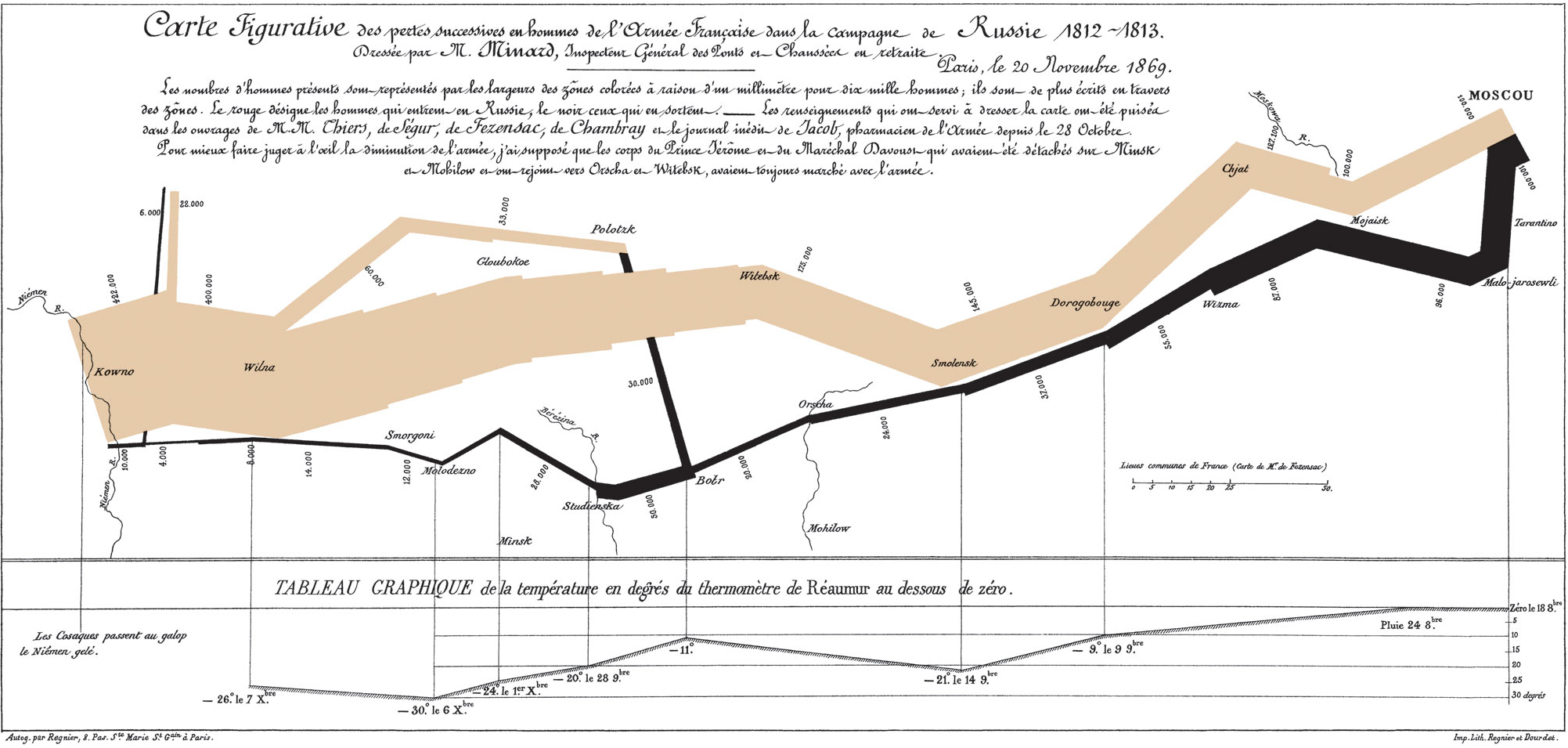
I've written before about Minard's chart of Napoleon's 1812 March on Russia, considered by many to be the best chart ever made in that it communicates many levels of detail with an economy of markings.


To read the chart, you should know that Napoleon's Grande Armée starts out as the wide, brown line on the left. 422,000 men crossed the Niemen River to begin the campaign. The Army is marching to the east, left-to-right. As the Army progresses further, soldiers die and the size of the force is reduced, indicated by the diminishing width of the brown line.

You'll also see where two splinter forces leave the main body to cover the supply lines and any possible retreat.

Eventually, a reduced French force arrived in Moscow, which the Russians had abandoned. There was very little food in the city, and fires broke out over several days. Napoleon was forced to retreat, and 100,000 men started marching west (signified by the black column).

Losses continued in their retreat, even as they rejoined the forces left behind. The weather turned very cold (the chart on the bottom shows the temperatures during the retreat). The final column that returned to cross the Niemen River westbound was 4,000 men from Moscow and 6000 men from the units left to cover the retreat.

This was a battle of logistics as well as of tactics; the French Army lost more men to starvation, desertion, typhus, and suicide than to combat. The Army advanced faster than supply trains could manage, and there was no forage available.

Best Mashup of 2009

Minard's chart tells this brutal story with elegance. Until recently, reproductions and redesigns of the information have been paper-based, but new work at Standford University has used a mashup of Google Maps and a visualization tool called ProtoVis to produce a digital presentation of Minard's chart.


The temperature scale presented uses the now obsolete Reaumur scale (°R), the same scale as Minard used.

Click here to see the chart in it's own webpage, where you can scroll, zoom in and out, and look at either Maps or Terrain. It's very well done, and conveys the efficiency of the original along with new tools.
December 27, 2009

NewYork Magazine Covers for the 00's Issue

I think I'm developing an appetite for clever magazine covers.

NewYork magazine had a design contest to choose a cover for their "00's issue". (click here for a slideshow).

Here are my two favorites, neither of which was selected:


December 24, 2009

Pong : Retro-Geek Gaming


Before the Wii, before DDR, a long time ago, back at the beginning, there was Pong.


Pong was the first mass-produced video game. It simulated ping-pong, played either between two players or between one player and the computer. The screen showed the position of two paddles, adjusted by the player twisting a knob, and the position of the ball. The score was also shown.

It was originally a coin-operated arcade console, but in 1975 it was released in home versions that used a television set as a display.


Now we've come full circle, and you can play Browser Pong on the Internet. Player One uses the A and Z keys to control their paddle, and Player Two uses the up and down arrows.

Instead of providing graphics within a window, this version of Pong actually uses windows as the paddles and the ping-pong ball. Its very true to the original experience. If it doesn't work for you, you may need to disable your pop-up blocker.

According to the website, Browser Pong was designed to demonstrate emerging HTML5 features, and is intentionally non-compatible with older browser versions and substandard browsers such as Internet Explorer. It works best in Safari 4, Chrome 4, FireFox 3.5, and Opera 10 in that order.

Browser Pong has got all the significant parts of the original Pong with one exception: no coin slot. Enjoy.
December 23, 2009

What Kind of Person Does That?


I was looking at the Drudge Report and I saw a teaser headline about Brittany Murphy's death that caught my eye.


Something didn't seem quite right. The phrasing seemed like more of a tentative assertion than an official report, and I didn't get their use of quotation marks. So I clicked on the link and was taken to CBS news and this headline:

I wondered — what kind of person offers opinions on a cause of death when the autopsy isn't finished and the family is still grieving? It continued:
"It's possible, certainly" (that Murphy died of natural causes), Dr. Cyril Wecht told "Early Show" co-anchor Maggie Rodriguez Tuesday, "and usually, it will be some kind of a congenital heart condition. But in most of those cases, the patient will be aware that there is some heart problem.

"When you have a 32-year-old person dying suddenly, and especially a celebrity in Los Angeles, you can place your bet down that it's going prove to be a case of acute combined drug toxicity. And I bet you that this young lady tragically died in the same way that Michael Jackson did, and Anna Nicole Smith, and her son, Daniel Smith, and Heath Ledger -- a combination of drugs that had been prescribed for her, prescribed for her husband, for her mother, in some fictitious names, probably by doctors who are very, very quick to make available anything that celebrities want, sometimes using knowingly fictitious names."
The following things jumped out at me:
  • Cyril Wecht!
  • They've underlined his name!
  • he's used the word bet twice!
  • Cyril Wecht! (wiki)
And then...

I clicked the underlined Cyril Wecht and discovered CyrilWecht.com. Who knew?

My first impressions of CyrilWecht.com included: (1)there's a curious code at the very top of the website, yellow text on red background, and (2) mid-page on the right margin there's a link that says: A note to funeral home directors. And I thought: that's just got to be interesting. So I read the note and found it was morbidly fascinating. I was surprised that he provides a 24x7 phone number on the web.

And then I was done with CyrilWecht.com.

A part of my mind tugged at me, my inner geek noodged me and I wondered, what was that code on the top of the website? On my browser (Firefox on XP-pro) there was just a single line of text displayed, it looked like this:


Autopsy No. 96A-155. What could this cryptic, arcane reference mean? Why is it so prominent? I googled "Autopsy No. 96A-155" and learned that this is the autopsy case file for JonBenet Ramsey, a little girl who was killed in Boulder, Colorado, on Christmas 1996.


Then I put my geek thinking cap on, and wondered: was there anything else to that image on the top of CyrilWecht.com? Could it be an easter egg, or does it lead to any more information? So I went back to CyrilWecht.com, and right-clicked the cryptic code, and clicked ViewBackgroundImage. And I saw this:

And I wondered, what kind of person uses the autopsy number of a dead little girl as the masthead image on their website?