Showing posts with label 3D printer. Show all posts
April 24, 2010

Geek Lust: HP's new 3D printer

(See Dec.2008 post on 3D printing)

Hewlett-Packard, which knows printers, is introducing a new 3-D Printer in Europe, with a later rollout in the United States. HP doesn't make the printer itself - a company named StrataSys does - but I suppose that's in keeping with the way things are done these days.

The new line of printers hopes to introduce rapid prototyping to design and engineering firms, and to eventually extend 3D printing to home hobbyists. The printer produces solid physical objects, in either a whitish-putty color or one of eight other colors (depending on the printer version).

How do you make a 3-D physical object? Well, how do you make a sculpture of an elephant? The classic advice (from Bernini) is, start with a big stone, and then take away everything that isn't an elephant. Michelangelo said a similar thing: "I saw the angel in the marble and carved until I set him free."

In modern 3-D printing, this is the reductive approach used by the MakerBot Cupcake machine, which uses CNC-style milling to reduce a block of material into the desired object.

There's never just one way to do things. Another path is to start off with nothing, just a clean space, and to deposit one very tiny bit of material. Then you keep adding tiny bits of material until you have an elephant. This additive approach is the path taken by the new HP printer (and also by the open-source RepRap machine).


Like the RepRap and Cupcake, the HP-Stratasys platform will operate using ABS plastic material. It's likely that the HP-Stratasys machine will, at least initially, be more like the additive approach used by Stratasys' existing Dimension line and the Reprap, not the CNC-style of the MakerBot Cupcake machine.

This new HP unit costs about US $17,000. (The open-source DIY versions run about $1000.) I remember when the new laser printers cost $20K. Eventually, the cost of the HP will come down, too.

It's going to be very cool to be able to fabricate (or print) physical objects in your garage. What's really going to be cool is when you also have a 3-D scanner. Then you can scan an object and print it, a sort of 3-D copy machine. Hmm, I guess you'd call that a replicator.

I really want one of these, but I think that what I truly want is for somebody else to pay for one and let me use it.
December 25, 2008

What I Did Not Get For Christmas 2008 (But Maybe for Christmas 2013 if I'm Good) : A 3-D Printer

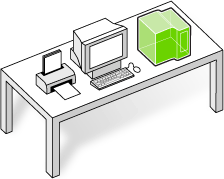
I did not get a 3-D printer for Christmas. It would fit on top of my desk, along with my monitor and my 2-D printer. (Yes, I've still got one of those old things!)


Inkjet printers can do a lot of things. Some restaurants are hacking their inkjets and replacing the inks with edible flavored dyes and printing on edible paper, giving their clientele edible menus that they can eat after they place their orders. Appetizers, sir? Oh no, please just eat your menu. No really, I mean it...


How does 3D printing work? Suppose you wanted to fabricate a sphere of 2-inch radius. The printer builds it in a thousand very thin layers. First the printer deposits a very thin layer of particle dust (plaster, corn starch, or resins) all across the printing area, say a five-inch square platform. Then the printer sprays ink onto the dust wherever the part is going to exist on that level. The dust that gets the ink solidifies, the dust that gets no ink remains powder and later blows away. Layer after layer build up. When it's done, a vacuum sucks out all the non-solidified dust, and then an Easy-Bake-Oven heats the output to solidify it as one peice. Let it cool off and presto, you've got a part. The products have the strength and properties of Lego blocks.


So these printers used to cost a million dollars, last year they cost $15K, and an outfit called Desktop Factory expects to sell them in 2009 for about $5K. This is just like personal computers all over again, in five years (Christmas 2013, hint, hint) they'll be priced at around $1000, and I'm going to want one.

What would you do with one? Make things! For instance, the tinkerers over at CandyFab.org are achieving 20dpi and making some pretty intricate sugar confections. Check out their site, best logo ever in the top-left corner.


In general, these 3D printers are corporate tools. But Another group of midnight engineers are building an open-source 3D printer called RepRap. RepRap is a plastic 3D printer. Here's the pitch that makes it unique: Once you assemble it, you use it to make (print) another one. It's a self-REPlicating RAPid prototyper. RepRap is an open source project, and although there's a lot of sweat equity and time involved in building one, it's going to cost $500 instead of $5000.

Right now, high school students are doing things with computers, scanners, and printers that only major corporations with large staffs could do thirty twenty years ago. Think about it - in 1988, what would it take to make a slideshow presentation with photo art? And print it in color? And make revisions and reprint? Today these are so easily done, we might forget how magical it is - which is the sign of a mature technology. For instance, nobody asks how the fridge keeps the beer cold.

Little Billy lost his house key? Print a new one. Cousin Sally forgot her night brace? No problem. Christmas eve and the mike stand for your Guitar Hero playset came out of the box broken? Hey, Dad can fix that! Visiting cousin (and bad boy) Stosh wants a Ninja Death Star? Sure -- oops, maybe not!

Does this affect the loss of manufacturing to China? Probably not, because desktop 3-D is still going to be more expensive than the China price. Will this support innovation and entrepreneurship? I think so.

Lest I get too positive, let me mention that if (as I believe) the unintended consequences of events outweigh the intended consequences - what will happen when bad people get these? To be sure, smart, funded bad people can get things made now; the change will be that more idiots will be able to obtain previously unobtainable items (like, for instance, rapid-fire trigger assemblies). (edited)

Another thing I find interesting is the shift in control. Previously, only factories and machine shops (which generally means people with money) held the means of production. With a 3D printer, that measure of control is lost and means of production become distributed. I don't want to sound like Karl Marx, who argued that limited distribution of the means of production exploits labor and produces the class system, but there's intriguing implications in this. As a geek, I just want the capability, but there's more in this than techno. (edited)

And finally, to kick it up a notch: remember those Star Trek chow hall replicators? That's where this ends up. Instead of printing big clunky parts somebody's going to make a molecular ink-jet using carbon nanotubes for the inkjet spray nozzles, and then all sorts of things will change.